First Sip:
“Now that defeat is so close, now there is so much to lose…
I ask you again: Send me to Orléans.”
…A moment of silence.
…Then: “Go.”
The command is a whisper, spoken like a secret.
“Go with our blessing, and we shall see if you are
truly as you say: an instrument of God.
Go and free Orléans. Though God help you, Joan,
if you fail.”
– from Joan
a novel by Katherine J Chen1
.
Slice of Cake:
It’s been my January tradition to write about
my mom, Elizabeth, and my patron saint, Joan of Arc.
One year I wrote about Joan according to George Bernard Shaw—
another year about Joan according to Mark Twain.2
Last January I wrote:
“Fascination with this 17-year-old soldier/saint/adventurer never seems to die out…
I wouldn’t be surprised to see Joan of Arc re-envisioned again soon!”
And, sure enough, last month I came across a new-to-me novel:
Joan by Katherine J Chen (2022).1
Any story about Joan of Arc is, by necessity, conjectural—
because there is so much of her life we don’t know.
In the novel’s afterword, Chen talks about
the liberties she takes with Joan’s story and
how she emphasizes Joan as “a soldier first.”
And where faith does come in, as Chen writes,
it’s less about the faith Joan has in God,
and more about the faith other people have in Joan.1

Gilded bronze sculpture of Jeanne d’Arc
by Emmanuel Frémiet (1874)
Place des Pyramides, Paris
.
The Joan of Chen’s novel has visions—
not visions of God, but visions of a free and unified France.
“The first time we spoke, Majesty,
you asked if I had visions. I have since had a vision,
and it is of France…”
– from Part Four of Joan
by Katherine J Chen
.
“You have seen heaven?” she asks.
Joan hesitates only a moment before answering.
“Yes, I have seen it.”
Joan doesn’t say…But it is only my version of heaven.
The one I created for Catherine, my sister,
to console myself in my grief.
– from Part Three of Joan
by Katherine J Chen
This Joan hears voices—
not the voice of St Catherine of Alexandria,
but the voice of her sister Catherine encouraging her on.
On the hill, she feels someone’s hand brush her arm…
though there is no one. She hears a voice that seems to
speak from the air: “Now go, Joan.”
– from Part Two of Joan
by Katherine J Chen
This Joan prays—though mostly in passing.
And she sets preparations above supplications.
“What choices does a woman have for vengeance, for justice?
For we cannot simply pray. I cannot stomach my mother’s prayers.
We cannot afford to wait and be still.
I won’t live this way—not anymore.
So when I spoke to God that morning, I decided,
if I am to scream, let it be in battle.
There is no chance for peace except at the point of a sword.”
– from Part Two of Joan
by Katherine J Chen
It is left to the people around her to accord her ‘the mantle of God’—
People like Duchess Yolande of Aragon…
Yolande says, “I do not profess to be a holy woman,
but I have had a vision of what you will become…
A banner of white…a famous sword…
a suit of white armor, polished to a shine.
You will become a holy warrior.”
…
Joan makes a face… It feels excessive, she wants to say.
A waste of money. “I have a sword already,” she says.
…
“Ah, I thought you would be quicker than this! …Do you
think the captains of France will rally behind a peasant, a mere girl?
Your abilities, your talents and gifts, are not enough.
You have no statues, no titles…
Either a woman must be raised high, higher than the heads of men,
or she will be crushed beneath their feet.
So we must raise you high… To the height of the heavens themselves.
We must dress you in the very mantle of God. Do you understand, Joan?”
– from Part Two of Joan
by Katherine J Chen
Joan of Arc in this novel is a tough, abused child who grows tall and strong.
Who is enthusiastic about swords and armor and combat training.
Who is practical about maps, canons, and the need to feed your foot soldiers well.
Who believes peace is the prize—and war is the mechanism to
win that prize for France.
Joan visits the new recruits:
the blacksmiths, the glaziers, the carpenters…
She tells them—reaching to clasp a dyer’s blue-stained hand—
“You are the heart of the French army. Do not let anyone say otherwise.
If any person belittles you or treats you badly…make a report
and tell me directly… I won’t abide cruelty, not among our own.”
– from Part Three of Joan
by Katherine J Chen
And most importantly for us readers,
this Joan is a wonderful, believable girl who grows up in a small village,
and then brings her past experiences along with her to think and re-think about them
as she travels and gains knowledge of the wider world.
Her strength no longer surprises her.
It is, she believes the natural outcome of such a childhood.
How else would she have survived if she didn’t grow strong?
…
Others in the village have asked her,
“What is it with you and fighting, Joan?”
…
When she thinks of these questions now, these are her answers:
Because I’ve been beaten most of my life…
because I don’t want what happened to Catherine to ever happen to me…
because I would like to think it is possible to be strong
without also being cruel.
– from Joan
by Katherine J Chen
Part Two
Happy 612th birthday
** Jeanne d’Arc **
– born January 6, 1412
in Domrémy, France
.
Linger Awhile:

One day…I’ll leave Domrémy.
Some people are born in a place, and they are
never able to see past its fences…
They reach..the edge of the forest, and they
turn around, go home.
They live beneath the same patch of sky and wait for..
good weather or rain to come to them.
But not me.
She tells herself: I’ll search out my own weather.
I’ll plunge into the unknown wood.
– from Joan
by Katherine J Chen
Part One
I’ve been thinking this week about my mom—
as I often do, and especially this time of year.

my mom in 1949
(photo by my dad)
My mom left home as a young woman. As did Joan of Arc. As did I.
We each “searched out our own weather.”
My mom left Northern Michigan in 1945, left the farm where she grew up.
I was back on that farm this past October for a family reunion—
a gathering my mother would have loved!
While in Michigan, a few of us took a side trip
to “plunge into the unknown wood.”
We visited the old-growth forest in Hartwick Pines State Park,3
with trees up to 150 feet tall and 400 years old.

Old Growth Trail with my 2 sisters & 2 cousins
Hartwick Pines State Park – October 2023
(photo by me)
Here’s the special thing about this beautiful park:
It’s one of the very, very few places left in Michigan
to see undisturbed, native forest.
That’s because in my great-grandparents’ time,
almost all of Michigan was logged.4
I remember my mom’s stories about seeking out
the long-abandoned logging camps with her brother and sisters—
to pick fruit from old apple trees that the loggers had planted,
and finding crumbling tin cans, and lots of broken
bottles of Eckhardt & Becker beer.
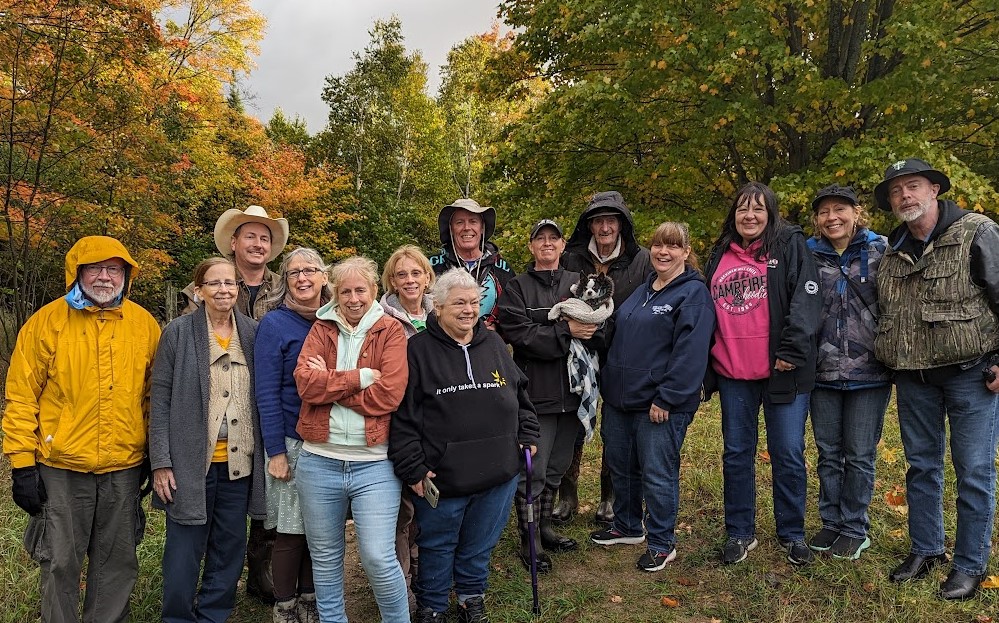
Me and a dozen first cousins…
It was a wonderful reunion!
Northern Michigan – October 2023
.
“Half Cup More”
“When did you learn to fight?” La Hire asked.
Hard to say. But she thought back…
She was thirteen. After church, a boy..said he’d had
dreams of Catherine..of creeping into her room…
Before she knew what she had done,
her fist had hooked his chin.
…
Behind her, she had heard a chuckle,
which made her turn.
…There was no one behind her, only the statue of
Saint Margaret that stood in front of the church.
Yet she could have sworn she
heard the chuckle again as she walked away.
– from Joan
by Katherine J Chen
Part Three
The traditional stories of her life say that
Joan of Arc heard voices and saw visions of God and the saints.
Two saints who are almost
always mentioned in stories about Joan of Arc:
St Margaret of Antioch and St Catherine of Alexandria.5,6
I did not recognize either of these saints’ names when they
showed up in Katherine Chen’s novel
(despite my Catholic upbringing).7
So… I did a little digging.
As she passes the cathedral of Orléans,
she mutters a prayer, a final word to God,
but a figure catches her eye…
A statue, its hand poised above a wheel.
She has seen this face before,
first in a book and then in a dream,
and its eyes are watching her.
– from Part Three of Joan
by Katherine J Chen
Both of these saints lived (if they lived at all) over 1000 years before Joan’s time.
Both of these saints had a dramatic escape from torture:
Catherine was to be tied to a wheel, but it broke when she touched it;
Margaret was swallowed by a dragon, then fought her way out with a metal cross.
Ultimately both were killed while still in their teens. Like Joan.
Of course, unlike Joan—who shows up in several historical records,
including court transcripts of her trials—
it is very possible that neither Margaret nor Catherine
were ever real people.5
But as far as traditional stories go,
these two saints share quite a few things in common with Joan:
A reputation for refusing marriage, for defying their fathers,
and for eloquently speaking truth to power.

St Margaret emerging from the dragon
detail of a miniature, circa 1497
British Library8
Margaret of Antioch is the patron saint of
pregnant women, servant maids, and kidney-suffers.
Her feast day is July 20th.5,7
Catherine of Alexandria is the patron saint of unmarried girls; potters, spinners, and
lacemakers; dying people; philosophers, scribes, librarians, teachers and students.
Her feast day is November 25th.6,7
.
Take-Away Box
The women step back to look at her…
and whisper a prayer
before this figure of steel they have prepared for battle.
Normally the squire would have dressed her,
but the women of the household wanted the honor.
It is as if Joan already belongs to them:
the mothers, daughters, wives, and sisters of the city
who look to her to lift the siege.
The men will free the men, but you will free us.
…
One more moment. One last prayer. Joan shuts her eyes,
though it isn’t a prayer that comes to her
but a memory…
A scene of peace in the house of white stone,
her sister still alive and mending a shirt.
Her uncle…said something that
made Catherine laugh…
“Our Joan,” Catherine said...
“She is always coming and going.
She can never keep still.”
…
Catherine looked at her thoughtfully.
Turning back to the cloth, she shook her head…
“Nothing can be done, and why should she change?
She is our Joan.”
When Joan opens her eyes again, she is
greeted by the world as it is.
– from Joan
a novel by Katherine J Chen
Part Three
.
STT-76
Thank you for reading!
— Kelly J Hardesty
Thoughts? Questions?
I would love to hear what you’re thinking!
Go ahead & scroll down to the end—where you can
leave me note in the comments box.
You Can Read More…
notes & footnotes
————————-
1.
Joan
a novel by Katherine J Chen
2022
Here is what Chen said in her Afterword:
There is no one who hears her story
who does not also feel a crackle of electricity in the air…
After six hundred years,
Joan is still a force to be reckoned with.
Many people are drawn to her. And why not?
… A young woman born in obscurity
who fought for what she loved, and who
lived her short life to the fullest.
– Katherine J Chen
2.
I talk about the 1896 novel
Personal Recollections of Joan of Arc
by Mark Twain
in my first sky-t-tray post back in January 2019:
https://sky-t-tray.us/january-6/
I talk about the 1923 play
Saint Joan by George Bernard Shaw
in my January 2023 post:
https://sky-t-tray.us/adventurer/
3.
Hartwick Pines State Park
3612 State Park Drive
Grayling, Michigan
Here is an article about the park by Emily Bingham
for MLive, May. 24, 2018
https://www.mlive.com/entertainment/erry-2018/05/2d6e4f0a071023/what_to_do_at_hartwick_pines.html
In Bingham’s article, she interviews Hillary Pine,
the Northern Lower Peninsula historian for the
Department of Natural Resources (DNR) and the Michigan History Center
(who says, yes, she is aware of the serendipity of her last name.)
At Hartwick Pines, you can see what
all of Northern Michigan used to look like.
…
You’re going to see
white pine and red pine and hemlock,
150 feet tall and 350 – 400 years old
…
No matter the time of year, you’re always going to
walk under this green canopy.
…
There’s about 49 acres of old-growth timber here—
a pretty big chunk for the Lower Peninsula—
especially considering the rampant logging that
happened from about 1850 to 1900.
– Hillary Pine
Here’s another bit I found interesting from Bingham’s article:
The forest here is not your typical Michigan woods.
Trees are much, much larger with less underbrush.
Even the forest floor is different—
it undulates in a ‘pit and mound’ phenonmenom—
a result of fallen trees creating hollows
where their root systems once were.
4.
Ghost towns left behind by the earliest loggers
by Lorene Parshall
The Petoskey News-Review
April 7, 2015
https://www.petoskeynews.com/story/news/local/gaylord/2015/04/07/ghost-towns-left-behind-by-the-earliest-loggers/45205943/
5.
St. Margaret of Antioch, Syrian saint
an entry in Encyclopaedia Britannica
https://www.britannica.com/biography/Saint-Margaret-of-Antioch
“Her designation as patron saint of
expectant mothers (particularly in difficult labour)
and her emblem, a dragon, are based on one of her trials:
Satan, disguised as a dragon, swallowed Margaret;
his stomach, however, soon rejecting her, opened,
and let her out unharmed.”
Margaret of Antioch is also known as
Margaret the Virgin and Saint Marina the Great Martyr.
The Wikipedia entry states that:
“she escaped alive
when the cross she carried
irritated the dragon’s innards.”
(no reference is given for this bit)
6.
The Life of Katherine the Saint
in The Golden Legend or Lives of the Saints
translated by William Caxton
“first published about 1470;
englished by William Caxton first edition 1483”
Thank you, Internet Archive, for access to this ancient book of saints!
https://archive.org/details/TheGoldenLegendVol7/page/n15/mode/2up?q=Catherine
“And then a master warned
and advised the king, being wood for anger,
that he should make four wheels of iron..so that she might be
horribly all detrenched and cut in that torment…
And anon as this blessed virgin was set in this torment,
the angel of our Lord brake the wheels by..great force.”
7.
I still have my mother’s Daily Missal, circa 1943,
(which was brand new when
she used it at her Catholic high school):
Saint Andrew Daily Missal
by Dom Gaspar Lefebvre O.S.B
of the Abbey of S. André, Bruges, Belgium
1943
Paging through, I found one small paragraph for Margaret;
and a short passage on Catharine.
(They are both on the list of “14 Auxiliary Saints.” Whatever that means.)
No mention at all of Joan.
My favorite bit from this Missal was identifying Catharine as a scholar:
Catharine was born at Alexandria.
From youth she combined the study of the liberal arts
with the ardor of faith.
8.
Photo of St Margaret emerging from the dragon
detail of a miniature from the Breviary of Queen Isabella
circa 1497
British Library
I found this picture on Memori,
a website of the Cardiff Medieval and Early Modern Reading Group
Cardiff University, Wales
Arthur Usher & Megan Leitch
January 22, 2018
https://memorireadinggroup.wordpress.com/2018/01/22/the-life-of-st-margaret-of-antioch-in-middle-english-31st-jan-2018/
STT-77
Please note:
Whenever you click on ‘Post Comment’ your comments always come to me first. Then I post them below.
If you’d rather they stay between us, just let me know.
sky-t-tray.us
© Kelly J Hardesty 2026
Thanks Kelly! I’m always interested in people who died young after making a big impression on the world, and then become a sort of archetypal Rorschach test for artists to explore themes that are important to them.