. . . . . . . . . . . . . . . . . . . .
On Today’s Menu:
. . . . . . . . . . . . . . . . . . . .
** Share some apple tea cakes for the birthday of a legendary writer.
** Linger to ponder a wonderful novel too often overlooked.
** Savor a last ½ cup perusing the collected works of three marvelously talented sisters.
. . . . . . . . . . . . . . . . . . . . . . . . . . . . . . . . . . . . . . . . . . . . . . . . . . . . . . . . . . . . . . . . . . . . . . . . . . . . . . . . . . . . . . . . . . . . . . . . . . . . . . . . . . . . . . . . . . . . . . . . . . . .
STT-78
First Sip:
If you think..that anything like
a romance is preparing for you—
Reader, you were never more mistaken.
Do you anticipate sentiment..and reverie?
Do you expect passion, and stimulus, and melodrama?
Calm your expectations;
reduce them to a lowly standard…
Something real, cool, and solid lies before you.
Something unromantic
as Monday morning.
– from Shirley
by Charlotte Brontë
first page
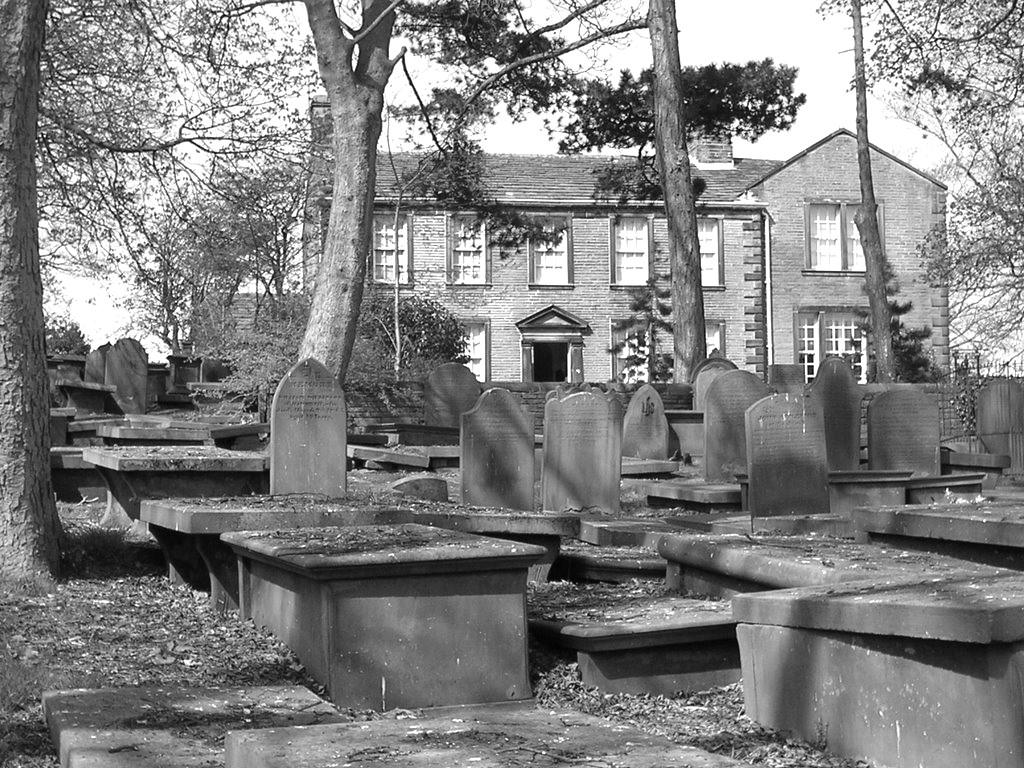
The austere setting of the Bronte’s home at
Haworth Parsonage in West Yorkshire, England.
It is now the Brontë Parsonage Museum.
photo credit: Adrian McKinty1
.
Slice of Cake:
There was nothing like them in these parts,
nor ever had been.
They had liked learning, all three,
almost from the time they could speak;
And they had always been ‘of a make of their own.’
– from Jane Eyre
by Charlotte Brontë
chapter 29
When Charlotte Brontë was 10 years old, her father returned from a short trip,
bringing a present of twelve wooden soldiers.
The toys were for Charlotte’s brother, Branwell—
But she and her two younger sisters immediately swooped in,
each choosing a favorite soldier.
When Papa came home…we were in bed
so next morning Branwell came to our door
with a box of soldiers.
Emily and I jumped out of bed, and
I snatched up one and exclaimed:
‘This is the Duke of Wellington! This shall be the Duke!’
When I had said this Emily likewise took one up…
When Anne came down, she said one should be hers.
Mine was the prettiest of the whole…
and the most perfect in every part.
Emily’s was a grave-looking fellow, and we called him ‘Gravey’.
Anne’s was a queer little thing—much like herself—
and we called him ‘Waiting-boy.’
Branwell chose his and called him ‘Buonaparte.’
– from Charlotte Brontë’s childhood papers
sent to biographer Elizabeth Gaskell
in ‘a curious packet..almost impossible to decipher’ 2
Their family had recently suffered a wave of tragedy.
It’d been less than a year since the two oldest sisters had died of tuberculosis.3
It’d been only four years since they lost their mother (probably to sepsis).16
Somehow, the simple wooden figures of this new toy inspired
a secret, imaginative, and highly creative society for the four surviving siblings.
Over the next decade, Charlotte, Branwell, Emily, and Anne created
and elaborately populated several fantasy worlds for their toy soldiers.6
There was no inducement to seek
social intercourse beyond our own
domestic circle.
– Charlotte Brontë
in an 1850 preface5
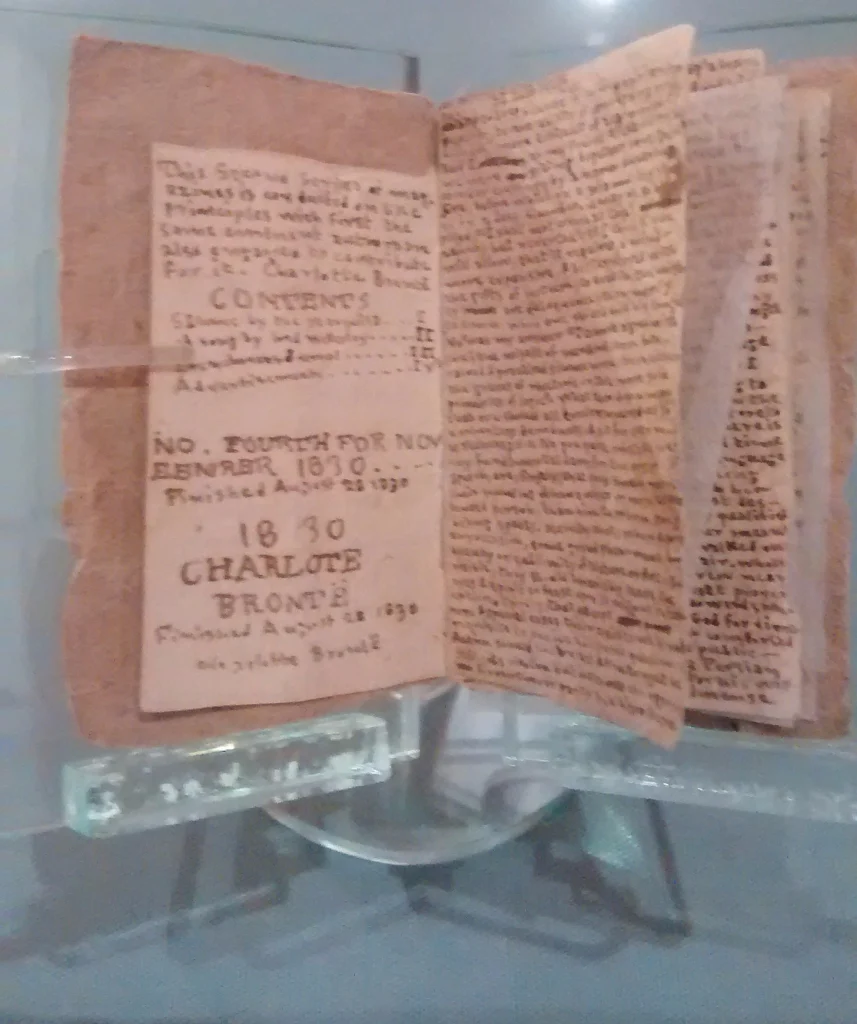
by the Brontë children
are now on display in the Brontë Parsonage Museum8
(photo credit: Nicola9
at Brontë Babe Blog)
And… why do we know about these childhood games?
Because they wrote them down—
recorded in the most minute handwriting, and
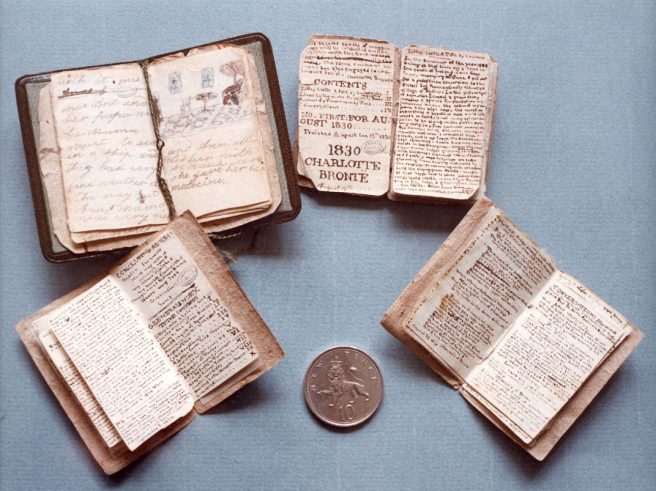
bound in tiny, hand-stitched books.
(The children wanted the books to be small enough
for their dolls to read.)6
Modern-day Brontë scholars have
rummaged through these childhood stories
searching for ideas and images that had later turned up
in the Brontë sisters’ novels—
A fire set on some bed curtains, for example,
is similar to a scene in Jane Eyre.)7
As the children became young adults,
Branwell left home to work as tutor.
His sisters tried working as governesses:
Charlotte had little success at this; Anne did a bit better.
Emily was completely hopeless and quickly gave up .
It it not in your nature to bear the desolate life
governessess generally lead; you would fall ill.
I won’t hear of it.
– from Shirley
by Charlotte Brontë
chapter 13
Finally, the three sisters tried their hand at writing...
They paid to have a volume of their poetry published.
It appeared in 1846 with the simple title Poems.
They used male-sounding pen names: Currer, Ellis, and Acton Bell.5
The poetry book sold only a few copies.
Yet the young writers felt encouraged to continue—
and each of the three sisters began writing a novel.
When all three novels were complete,
the Brontës began submitting them to publishers—again using their pen names.14
Three Novels Submitted for Publication
* * * * * * * * * * * * * * * * * * * *
The Professor by Currer Bell …(aka Charlotte)
Wuthering Heights by Ellis Bell …(aka Emily)
Agnes Grey by Acton Bell …(aka Anne)
In time, Anne’s and Emily’s novels were accepted—
while Charlotte’s novel was repeatedly rejected.4,10
Charlotte kept trying until one publisher—
though he also rejected it—sent her two-pages of notes,
filled with praise and writing advice.
What’s more, he encouraged her to try again with a longer work.5
But [he]..discussed its merits and demerits
so courteously, so considerately…
This very refusal cheered the author.
– Charlotte Brontë
in an 1850 preface5
Within months, Charlotte had submitted a second novel: Jane Eyre.
This one was quickly accepted
(by the publisher who’d sent the ‘courteous’ letter).
Jane Eyre was an immediate success.
It received lots of attention—and mixed critical review.
It sold extremely well, making money for Charlotte…
Something like 25 times what she made as a governess.11
Charlotte’s success prompted Emily and Anne’s editors—
who had been dragging their feet about publishing—
to quickly bring out their novels as well.
Which is why…
Jane Eyre, Agnes Grey, and Wuthering Heights
were all published in the same year: 1847.
The very next year,
Anne published her second novel: The Tenant of Wildfell Hall.
There is some evidence that Emily was either writing a second novel—
or planning to. But nothing of this novel has ever been found. 4
Meanwhile, Charlotte was half-way done with her third novel: Shirley.
Then came the second wave of tragedy for the Bronte family.
In less than a year—between September 1848 and May 1849—
first their brother Branwell, then Emily, then Anne died
of bronchitis and tuberculosis.
The pen, laid down when there were
three sisters living and loving,
was taken up when one alone remained.
Well might she call the first chapter
that she wrote after this:
‘The Valley of the Shadow of Death.’
– from The Life of Charlotte Brontë
by Elizabeth Gaskell2
Once a child with five siblings, Charlotte Brontë was now,
at age 33, a woman living alone with her widowed father.
When anything ails Papa,
I feel too keenly that he is the last—
the only near and dear relative I have in the world.
Yesterday and to-day he has seemed much better,
for which I am truly thankful.
– Charlotte Brontë
in a letter to a friend
August 23, 1849
Yet she wrote on.
Within the next year, Charlotte finished Shirley—
and saw it published.
And, yes, there is a chapter called ‘The Valley of the Shadow of Death.’
But in fiction, the illness passes, and the heroes of her story
persevere and even triumph.
What I find particularly poignant is how Charlotte, over and over,
writes about joy, yet contrasts it with sorrow:
She writes of worries that proved needless—but evocatively details the worries;
she writes of tragedy that was narrowly avoided—but meticulously describes
the tragedy which—in her fiction—doesn’t happen.
A certain look had passed
from her face and eye—
a look dread and indescribable,
but which will easily be recalled by those who
have watched the couch of dangerous disease.
– from Shirley
by Charlotte Brontë
chapter 25
In other words, Charlotte Brontë found a way to express some of her pain
and her tragic experiences without writing a tragic story.
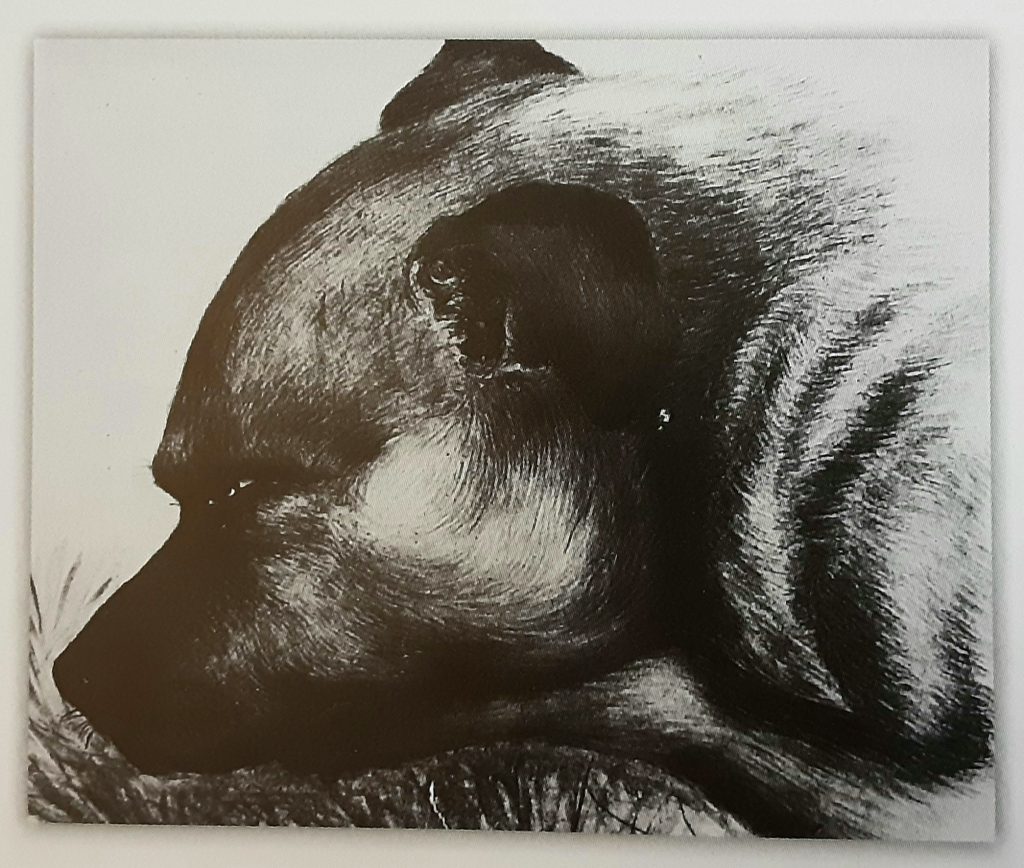
Charlotte Brontë’s biographer writes that the character of
Shirley Keeldar is based on how Charlotte imagined
her sister Emily Brontë might have turned out—
if Emily had had the benefits of health, wealth, and privilege.2
One definite connection between Shirley and Emily is that
in the novel, Shirley has a big dog named Tartar,
(“rather large, strong, and fierce-looking…
a breed between mastiff and bulldog.”)
who sounds a lot like Emily’s real dog, Keeper.
(I’ll talk more about Shirley below…)
The faculty of imagination lifted me
when I was sinking three months ago;
its active exercise has kept my head above water since;
its results cheer me now…
I am thankful to God… It is, for me, a part
of my religion to defend this gift,
and to profit by its possession.
…
I must have my own way in the matter of writing.
– Charlotte Brontë
in a letter to her editor
September 21, 1849
.
Happy 208th Birthday
** Charlotte Brontë **
– born April 21, 1816
in West Yorkshire, England
.
Linger Awhile:
We will go—
you and I alone, Caroline—to that wood,
Early some fine summer morning, and
spend a long day there.
We can take pencils
and sketch-books,
And any interesting reading book we like;
And, of course, we shall
take something to eat…
– from Shirley
by Charlotte Brontë
Chapter 12
I’ve been thinking this week about why some books
are read and loved—while other, equally good books are not.
Jane Eyre by Charlotte Brontë is almost universally read—
and regularly debated.
Shirley, which is also by Charlotte Brontë, is rarely read.
Why? Why is one so often loved, while the other is so often overlooked?
Shirley is a wonderful book.
Not better than Jane Eyre, but different—
touching on more wide-ranging social and economic issues.
But before I talk about Shirley (and get into spoiler territory)
how about I give you some spoiler-free recommendations?
Just a handy (and very brief!) guide to take away with you—
in case you’re dashing off to your nearest public library…
The Brontë Novels I Like Best
#1 Shirley—so under-rated and so rewarding!
#2 Jane Eyre—a world-wide classic for a reason.
#3 (a tie!) Villette and Agnes Grey—
the Brontës poured their real-life experiences into these two novels.
(I think I like Villette better, but Agnes Grey is much shorter—
so it’s probably the better one to start with!)
For more about the other Brontë novels—
and a lot more about of Shirley—
read on…
Spoiler Warning…
If you’ve never read Shirley by Charlotte Brontë
be warned that there are a few spoilers ahead.
But honestly, Shirley is full of surprises—
and I’m not giving away any of them!
(But to avoid all spoilers,
you can skip down to “Half Cup More” here)
3 Reasons
To Read Shirley…
and…
2 Reasons
Why You Probably Have Not!
A Rich Friendship
Despite the novel’s title, the main character is Caroline Helstone—
not Shirley Keeldar.
Caroline was brought up by her uncle, the Reverend Matthewson Helstone,
having lived with him since she was a small child.
As the book opens, Caroline is 18 years old—still a minor—and her uncle is still her legal guardian.
She describes Mr Helstone as “neither tyrannical nor hypocritical,” but he is also
neither interested in nor affectionate with her.
And yet, it is this inattentive uncle who introduces Caroline to a new friend: Shirley.
(Rev Helstone)
Get your bonnet on. I want you to make a call with me.
(Caroline)
With you, uncle?
(Rev Helstone)
Quick! quick!
…
We are going to see Miss Shirley Keeldar…
I met her at a party last night—
that party to which you would not go.
I am pleased with her.
I choose that you shall make her acquaintance.
It will do you good…
She will teach you what it is to have a sprightly spirit.
Nothing lackadaisical about her.
– from Shirley
by Charlotte Brontë
Chapter 11
The friendship which slowly grows between Shirley and Caroline
is my favorite thing about this novel.
(Shirley)
You did not want my society this afternoon,
and I feel it hard.
You are naturally somewhat reserved,
but I am a social personage, who cannot live alone…
Not for the fraction of a second
do I ever wish to be rid of you.
You cannot say as much respecting me.
(Caroline)
Shirley…I like you…
You know I am too English
to get up a vehement friendship all at once;
but…I esteem you, I value you;
You are never a burden to me—never.
Do you believe what I say?
(Shirley)
Partly…but you are a peculiar personage.
Quiet as you look, there is both a force
and a depth somewhere within,
not easily reached or appreciated.
– from Shirley
by Charlotte Brontë
Chapter 14
How Shirley Keeldar stands up for herself.
He had not imagined that a woman
would dare to speak so to a man.
– from Jane Eyre
by Charlotte Brontë
Chapter 32
Shirley also has an uncle,
a Mr Sympson. He was her guardian—
but Shirley is now 21. A legal adult.
Yet, Mr Sympson still firmly believes that
he has power over Shirley—
especially when it comes to choosing a husband for her.
(Mr Sympson)
Such obstinancy…!
Are you a young lady?
(Shirley)
I am a thousand times better:
I am an honest woman,
and as such I will be treated.
– from Shirley
by Charlotte Brontë
Chapter 31
Shirley listens to her uncle for a while,
but she sticks to her own decisions.
(Shirley)
I will hear no more.
Your thoughts are not my thoughts,
your aims are not my aims…
We hardly speak in the same tongue.
…
You are a good sort of man… But we cannot suit…
You annoy me with small meddling,
with petty tyranny, you exasperate my temper…
I am anchored on a resolve you cannot shake.
My heart, my conscience shall dispose of my hand—
they only.
Know this at last.
– from Shirley
by Charlotte Brontë
Chapter 31
And if you enjoy this,
wait till you hear how Shirley talks to her suitor!
Surprising Candor
One thing that can be frustrating in classic novels
is how people never seem to say how they really feel.
That’s why I was surprised at the refreshing honesty
in conversations between Caroline and Robert—
two young, unmarried characters in Shirley.
(Robert)
I believe I should counsel [you]..to exclude one who
does not profess to have any higher aim in life than that of
patching up his broken fortune…
(The hint,
though conveyed thus tenderly and modestly..
[Caroline] felt keenly and comprehended clearly.)
…
(Caroline)
I am beginning to understand things
better than I did, Robert…
I know it is your duty to try and get on,
and that it won’t do for you to be romantic.
But in the future you must not
misunderstand me if I seem friendly.
– from Shirley
by Charlotte Brontë
Chapter 7
2 Reasons
Why Most People Have Not Read Shirley
Shirley is not Jane Eyre
Jane Eyre was so popular,
Readers naturally wanted more of the same.
Instead, Charlotte Brontë’s next novel was… something else.
Shirley is not told in the first person,
it does not stick with just one character’s point of view,
and it is not a romance—
(Although… when Brontë warns us that this novel is going to be
as “unromantic as a Monday morning,” she’s not being entirely honest…)
There is quite a bit of romance in Shirley.
But it’s not like Jane Eyre—where romance
and moral development are main themes.
Instead, Shirley has a big cast of characters. (All those curates. All those Yorkes.)
It shows us people clashing over economic hardships and labor disputes.
This book is where I learned who the original Luddites were—
what they wanted, and what they did when they couldn’t get it!
Readers wanting a novel more like Jane Eyre,
might like Agnes Grey or Villette or even The Tenant of Wildfell Hall better.
Those First 4½ Chapters!
But I think the real reason that people don’t read Shirley,
is how slowly it gets started.
Reading those opening chapters for the first time—
chapters mostly about very minor characters—can be a very slow trudge.
Of late years
an abundant shower of curates
has fallen upon the north of England:
They lie very thick on the hills;
every parish has one or more of them…
– 1st line of Shirley
by Charlotte Brontë
(okay, yes, this is funny;
but four chapters with these
particualar curates is…a lot)
Shirley doesn’t even come in until Chapter Eleven!
However, we do get to meet Caroline—
she enters “in haste” about half-way through Chapter 5.
And then… we’re into it!
Now, if you’d like some hints on how to skip this slow start—
and instead start where it’s getting good—
I’ve got that mapped out for you here.
.
“Half Cup More”
It is a soaking, rainy day…
I am alone in my library, and have been
looking over..old letters and papers, and
musing on past times.
…
I am now in a very proper frame of mind for
amusing you with an old-world story…
I know you like a long story…
so I will not spare you.
– from the opening pages of
The Tenant of Wildfell Hall
by Anne Brontë
3 sisters. 7 novels.
Let’s take a short tour—
Starting with 2 novels by the youngest Brontë, Anne.
Novels by
Anne Brontë:
** Agnes Grey (1847)
** The Tenant of
Wildfell Hall (1848)
Novels by
Emily Brontë:
** Wuthering Heights (1847)
Novels by
Charlotte Brontë:
** Jane Eyre (1847)
** Shirley (1849)
** Villette (1853)
** The Professor (1857)
Agnes Grey
by Anne Brontë
How delightful it would be to be a governess!
To go out into the world…
to act for myself…to earn my own maintenance…
to show Papa what his little Agnes could do.
– from Agnes Grey
by Anne Brontë
chapter one
I was charmed by the opening chapters of Agnes Grey.
It talks of a family of sisters at home—and how the
youngest sister, Agnes (our main character), feels that she
is treated too much like a child—
and isn’t appreciated for what she could contribute.
“Mama, I am above eighteen and quite able to
take care of myself and others, too.
You do not know half the wisdom
and prudence I possess
because I have never been tried.”
– from Agnes Grey
by Anne Brontë
chapter one
Do you think that maybe Anne, as the youngest Brontë sister—
telling this story of a character feeling underrated—
might have been writing from experience?
Though a woman in my own estimation,
I was still a child in theirs.
– from Agnes Grey
by Anne Brontë
chapter one
After a struggle to convince her family to allow her to go,
Agnes leaves home to work as a governess.
First with one family, then later with another.
The first job is rough for Agnes—
and rough for us readers, too.
(Especially if you’re an animal lover.
Or if you don’t believe in physical punishment for children…)
Job #2 is much better, though still difficult.
I enjoyed the characters and relationships Agnes is able to build
in these new surroundings of her second job.
Honestly, when I re-read Agnes Grey—
which I very much enjoy doing—
I skip over the parts (chapters 3-5) that describe her first governess job.
I feel it my duty
to speak an unpalatable truth.
– Anne Brontë
in a letter to a friend10
Agnes Grey is a slim novel. (My copy is less than 200 pages.)
A lot of people say this is their favorite Brontë novel.
If you like short novels that are very quiet, very realistic,
and are clearly taken from real life experiences—
perhaps Agnes Grey could be your new favorite, too.
The Tenant
of Wildfell Hall
by Anne Brontë
“You cannot mean that you will
break your heart and die for..a villian like that!”
“By no means.
My heart is too thoroughly dried to be broken…
and I mean to live as long as I can.”
– from The Tenant of Wildfell Hall
by Anne Brontë
chapter 39
Many, many people love this novel.
Honestly, I am not one of them.
I can see the high quality writing and fascinating themes—
especially for a book written in the mid-19th century!
My problem with The Tenant of Wildfell Hall is that its first narrator
is neither compelling—nor is he a very good guy!
(Look how he treats his old flame, Eliza.
Or what he does to Frederick!)
Later we switch points of view—
and get into a diary written by the main character—
I really hoped I’d like this section better.
But no. In the diary, we watch this young woman
make a very bad mistake—in very slow motion.
I liked the little boy. I liked the dog.
I’m afraid that’s about it.
It seems Charlotte didn’t think much of Anne’s second book, either.
She was horrified that Anne had fictionalized
their brother Branwell’s struggles with alcohol addiction.
She believed it to be a
duty to reproduce every detail
(of course with fictious characters…)
as a warning to others.
– Charlotte Brontë
in an 1850 preface5
Despite my (or her sister’s!) opinions…
If you’d like to try a brave book about difficult subjects,
with a strong female character making tough choices—
plus a dog! (a “beautiful black and white setter” named Sancho)—
You should give Anne Brontë’s The Tenant of Wildfell Hall a read.
Wuthering Heights
by Emily Brontë
Wuthering Heights was
hewn in a wild workshop.
– Charlotte Brontë
in an 1850 preface5
This is the only novel that Emily wrote.
(That we know of…)4
I can see the genius of Wuthering Heights.
But… it’s not for me.
(I don’t like revenge stories and I don’t like cruelty.
And this novel is very full of both.)
Along with the one novel, Emily also wrote poetry.
And, of the three sisters, Emily Brontë is the best poet.
Charlotte said so. And history agrees.
The book [of poems] was printed:
It is scarcely known.
And all of it that merits to be known
are the poems of Ellis Bell.
– Charlotte Brontë
in an 1850 preface5
Poetry Foundation12—a wonderful site for
finding poems online—currently has 15 poems by Emily Brontë.
But only two poems by Anne Brontë.
And just one by Charlotte.
These were not common effussions,
nor at all like the poetry women generally write.
I thought them condensed and terse,
vigorous and genuine…
They had also a peculiar music—
wild, melancholy, and elevating.
– Charlotte Brontë
in an 1850 preface5
Here is a poem by Emily Brontë
about not wanting to leave the moors, where she so often walked alone with her
faithful dog, Keeper. The poem is called: The Night is Darkening Round Me.12
The night is darkening round me,
The wild winds coldly blow;
But a tyrant spell has bound me,
And I cannot, cannot go.
The giant trees are bending
Their bare boughs weighed with snow;
The storm is fast descending,
And yet I cannot go.
Clouds beyond clouds above me,
Wastes beyond wastes below;
But nothing drear can move me;
I will not, cannot go.
– Emily Brontë
Jane Eyre (1847)
by Charlotte Brontë
I am not writing to flatter…
I am merely telling the truth.
– from Jane Eyre
by Charlotte Brontë
chapter 12
There is something about the character of Jane Eyre:
How deeply we get to know her.
How complex are her strengths and faults.
And just how hard-won are those moral stands she takes.
I care for myself.
The more solitary, the more friendless,
the more unsustained I am,
the more I will respect myself.
…
Principles are not for the times when there is no temptation:
they are for moments as this,
when body and soul rise in mutiny against their rigour.
– from Jane Eyre
by Charlotte Brontë
chapter 27
This is Charlotte Brontë’s masterpiece.
Much as I love Shirley—I’ll honestly say,
if you’re going to pick up one and only one Brontë book—
Jane Eyre is the one you’ll want to read and re-read.
It reads like a page out of one’s own life…
It is soul speaking to soul.
– critic George Henry Lewes in 1847
about Jane Eyre4,10
Honestly, now when I re-read Jane Eyre,
I tend to skip the first cruel chapters about her hard childhood,
(I like to start reading at Chapter 10, when Jane as an adult.)
Charlotte takes her characters and explores
their inside lives,
what’s going on in their minds…
the way they think about themselves
and the way they feel.
– Lucy Powrie13
November 2018
Controversially, there’s one character in Jane Eyre
whom we don’t get to know.
But a 1966 novel by Jean Rhys gives this silent character her own voice.
I heard them quarrelling…
I knew it was about my marriage.
…
“It’s shameful. You are handing over
everything the child owns to a perfect stranger.
She should be protected, legally.”
…
“You are talking about an honourable gentleman…
She’s damn lucky to get him, all things considered.
…I would trust him with my life.”
…
“You are trusting him with her life,
not yours.”
– from The Wide Sargasso Sea
by Jean Rhys (1966)
Shirley (1849)
by Charlotte Brontë
I’ve already said how much I love this novel—
other than its slooow beginning!
If you want an easy way in to this story,
here’s how to skip a bit—and start in on the good parts.
(With the idea you’ll come back later to pick up those first few chapters.)
My Reading-Order Recommendation for Shirley
#1 Begin about half-way through Chapter 5;
Starting where Robert says to his sister:
“I am afraid you are not very happy in England, Hortense.”
And Hortense replies:
“It is my duty to be happy where you are, brother;
but otherwise there are certainly a thousand things which make me regret…”
Then simply read on from there.
#2 If at some point you become curious about mentions of
‘prisoners rescued’ and ‘the wagon attacked.’—
you can get all that whole story in this small bit:
Begin the last 3½ pages (or so) of Chapter 2—
Starting with the paragraph that says “Misery generates hate”
and then read to the end of the chapter.
#3 If you’re loving the book (and I hope you will!) you can go back later
and read from the beginning!
Villette (1853)
by Charlotte Brontë
No mockery in this world ever sounds to me so hollow
as that of being told to cultivate happiness.
What does such advice mean?
Happiness is not a potato,
to be planted in mould, and tilled with manure.
Happiness is a glory shining far down upon us…
A divine dew which the soul,
on certain of its summer mornings,
feels dropping upon it…
– from Villette
by Charlotte Brontë
Chapter 22
To start with,
the main character’s name is Lucy Snowe, not Villette.
Villette is a fictional town in Europe.
(The setting seems to be based on a real school in Brussels
where Charlotte both taught and took classes—just like her fictional Lucy does.)
What I enjoy about Villette is getting to know Lucy…
To hear everything she went through, and everything she felt.
About her travel experiences: good and bad;
About self-reliance and depression;
About both enjoying solitude and feeling deeply lonely.
Here’s Lucy’s Travel: Good…
I did well to come.
…I like the spirit of this great
London which I feel around me.
…
The amount of life I lived that morning…
I went wandering whither chance might lead,
in a still ecstacy
of freedom and enjoyment.
– from Villette
by Charlotte Brontë
Chapter 6
And her Travel: Good then Bad…
Deep was the pleasure I drank in
with the sea breeze…
I saw the continent of Europe…
Sunshine lay on it, making the long coast one line of gold;
…For background, spread a sky, solemn and dark-blue…
Cancel the whole of that,
if you please, reader…
Becoming excessively sick,
I faltered down into the cabin.
– from Villette
by Charlotte Brontë
Chapter 6
Her Independence: Good…
My time was now well and profitably filled up.
What with teaching others and studying closely myself,
I had hardly a spare moment.
It was pleasant. I felt I was getting on…
polishing my faculties and
whetting them to keen edge with constant use.
– from Villette
by Charlotte Brontë
Chapter 9
And her Independence: Lonely…
There falls a stilly pause, a wordless silence,
a long blank of oblivion…
Seven weeks as bare as seven sheets of blank paper:
no word was written on one of them;
not a visit, not a token.
– from Villette
by Charlotte Brontë
Chapter 24
The Professor (1857)
by Charlotte Brontë
I have been told since,
that Dr Bretton was not so nearly perfect
as I thought him:
That his actual character lacked the depth,
height, compass, and endurance
it possessed in my creed…
– from Villette
by Charlotte Brontë
Chapter 22
Of Charlotte Brontë’s four novels,
The Professor was written first—but published last.
After nine publishers soundly rejected The Professor during 1846,
Charlotte put it away in a cupboard.4
Some five years later—after success with both Jane Eyre and Shirley—
Charlotte began reworking many of the ideas and themes from The Professor
to create a new novel, Villette.
I’ve sometimes heard The Professor described as a rough draft for Villette.
(Honestly, I’ve not read The Professor, and I probably never will.)
The Professor was finally published—
but not until two years after Charoltte had died.15
I don’t know.
He was as good to me as the well is
to a parched wayfarer…
I remember him heroic.
Heroic at this moment will I hold him to be.
– from Villette
by Charlotte Brontë
Chapter 22
.
Take-Away Box
(Shirley):
It would not tire you too much
to walk so far?
(Caroline):
Oh no,
especially if we rested the whole day in the wood.
And I know all the pleasantest spots.
…
(Shirley):
You would be dull with me alone?
(Caroline):
I should not.
I think we should suit.
And what third person is there
whose presence would not spoil our pleasure?
(Shirley):
Indeed, I know of
none about our own ages—no lady at least.
And as to gentlemen—
(Caroline, interrupting):
An excursion becomes quite a
different thing when there are gentlemen…
Quite a different thing to what
we were proposing.
…
(Shirley):
We were going simply to see old trees
…surrounded by olden silence.
…
(Caroline, sagely):
Our power of being happy
lies a good deal in ourselves, I believe.
– from Shirley
by Charlotte Brontë
Chapter 12
.
Thank you for reading!
— Kelly J Hardesty
Thoughts? Questions?
I would love to hear what you’re thinking!
Go ahead & scroll down to the end—where you can
leave me note in the comments box.
notes & footnotes
—————————
1.
photo credit for Haworth Parsonage photograph
Adrian McKinty is an Edgar Award winning mystery novelist
https://adrianmckinty.blogspot.com/2015/08/a-visit-to-brontes-parsonage.html
His blog is called Adrian McKinty: the psychopathology of everyday life
Post on August 14, 2015: “A Visit To The Brontë Parsonage”
2.
The Life Of Charlotte Brontë
by Elizabeth Gaskell
1857
In 2017, The Guardian newspaper named
The Life of Charlotte Brontë by Elizabeth Gaskell
as one the 100 Best Nonfiction Books of All Time
Gaskell wrote this biography of her friend Charlotte Brontë, at the request of
Brontë’s father, Patrick, during the months after Charlotte died.
Gaskell lovingly researched her book, traveling to collect letters
and interviews from people who knew the Brontës.
Yet the closer Gaskell got to finishing her biography, the more anxious she felt:
There were so many disagreements on essential details of Charlotte’s life.
Gaskell was worried she’d be blamed for inaccuracies…
And, as it turned out, she was right to be concerned.
Two separate parties threatened libel suits against Gaskell
after her biography of Charlotte Brontë was published.
You can read more about Elizabeth Gaskell
in my post from September 2018 called Escape to Italy
https://sky-t-tray.us/escape-to-italy/
3.
The two oldest children in the Brontë family, were named
Maria (named after their mother) and Elizabeth (named after their maternal aunt).
They both died at home in June 1825 of tuberculosis—
which they caught after a typhoid outbreak at their boarding school.
Both Charlotte and Emily were also at that school:
Cowan Bridge School in Lancashire, which was
a Clergy Daughters’ School (and therefore was affordable education
for the Reverend Patrick Brontë’s five daughters).
Their father brought Maria and Elizabeth home from school when they became sick.
He brought Charlotte and Emily home after their sisters died.
(Anne was still to young to attend.)
Charlotte later used the school’s poor health conditions and brutal discipline
as a basis for her fictional Lowood School in Jane Eyre.
4.
Charlotte Brontë: A Fiery Heart
by Claire Harman (2015)
(I read a library copy of the Alfred A Knopf hardback © 2016)
…was repeatedly rejected
The editor who accepted Emily and Anne’s novels
may not have been sent The Professor, as sometimes
the Brontës were submiting their novels separately.
(see footnote #10 for an alternate reason why
The Professor wasn’t accepted for publication)
…some evidence
There’s a letter to Emily from her editor saying he’d be happy to
help in “making arrangements” for it and advising her to
“not let it go before the world until [she is] well satisfied with it.”
Any letters from Emily to her editor on this topic are lost.
“It reads like a page out of one’s own life“
Harmon goes on to say that G H Lewes ‘seemed spellbound
by the book’s “psychological intuition”‘
(Harman p258)
…put it away in a cupboard
Charlotte tried nine times
before giving up on The Professor—then she put it away
in a ‘cupboard by itself’ rather than keeping it in her desk.
(So she wouldn’t accidentally come across it and feel sad!)
5.
Biographical Notice of Ellis and Acton Bell and
Editor’s Preface
to the New Editions of Wuthering Heights and Agnes Grey
by Currer Bell
September 19, 1850
Charlotte Brontë wrote this preface to the 1850 editions
of Wuthering Heights and Agnes Grey,
In it, she publicly revealed for the first time
the true names of Currer, Ellis, and Acton Bell
were Charlotte, Emily, and Anne Brontë.
Emily and Anne had died less than a year earlier.
Charlotte hoped to help promote her sisters’ novels,
which she felt weren’t getting the attention they deserved,
especially compared to the popularity of Jane Eyre.
6.
Finola Austin at
Secret Victorianist
https://www.secretvictorianist.com/2017/07/traces-of-angria-and-gondal.html
Her author website is www.finolaaustin.com
7.
A Tiny Brontë Book Comes Home
by Jennifer Schuessler
New York Times
Nov. 18, 2019
https://www.nytimes.com/2019/11/18/arts/design/charlotte-bronte-book.html
This is a 2019 news story about how the
Brontë Parsonage Museum paid $777,000
for one tiny, hand-stitched book of the Brontë children’s stories.
The money came from crowdfunding plus groups like
the UK’s National Heritage Memorial Fund,
and from private donations, including from Judi Dench,
who was then the honorary president of the Brontë Society.
(Dench played the kindly Mrs Fairfax, the housekeeper of Thornfield Hall,
in the 2011 movie of Jayne Eyre.)
8.
Brontë Parsonage Museum
https://www.bronte.org.uk/
The Brontë Society has run this museum since 1928—
the year the Society was finally able to buy the home that the Brontë family moved into
when Charlotte was only 4 years old (and Anne was an infant) and
then all spent the rest of their lives there.
The Brontë Society first formed in 1893 as a literary society in general; but specifically,
to begin buying back and saving manuscripts and keepsakes of the Brontë family—
including all those tiny books they had created as children, which had been
bought up or outright stolen by sightseers, fans, and visitors to the parsonage
while their father, Patrick, still lived there.
9.
Photo credit: Nicola at Brontë Babe Blog
The photo was taken at the Brontë Parsonage Museum in 2016
https://brontebabeblog.wordpress.com/2021/10/03/toy-soldiers-tiny-books-and-an-enormous-world/
The one tiny book pictured on a clear stand
was made in 1830
handstitched by Charlotte Brontë, age 14
featuring stories by the Brontë siblings.
Size: 2¼ x 1½ inches,
around 20 pages,
more than 4000 words (!)
10.
The Brontë Sisters:
The Brief Lives of Charlotte, Emily, and Anne
by Catherine Reef
2012
“It is soul speaking to soul…
It is an utterance from the depths of a struggling , suffering,
much-enduring spirit.”
For the other half of the G H Lewes quote see Harman’s book.
(Footnote #4)
…was repeatedly rejected
The editor who accepted Emily and Anne’s novels
may not have rejected The Professor outright;
It could be that Charlotte wasn’t willing to pay all the
publication fees that her sisters paid to get theirs accepted.
(see footnote #4 for an alternate reason
The Professor wasn’t accepted)
11.
Charlotte Brontë Statistics
by Dean Talbot
from his words rated website
December 8, 2022
Find many more statistics about the Brontës by Talbot:
https://wordsrated.com/charlotte-bronte-statistics/
12.
Poetry Foundation
https://www.poetryfoundation.org/poets/emily-bronte
13.
My Favourite Book in the World
a video by Lucy Powrie
at lucythereader
Nov 27, 2018
https://www.youtube.com/watch?v=85ZbjaU8ZcM
14.
There was sooo much speculation
about who the Bells were.
And whether they were men or women,
or all the same person.
Biographer Claire Harman tells a story about John Greenwood,
the bookshop owner in Haworth,
who praised the Rev Brontë’s daughters as “so gentle and kind”—
but wondered how they could be using up so much writing paper so fast.
“When I was out of stock…they seemed so distressed…”
He told Elizabeth Gaskell that he’d much rather walk 8 miles to get
more paper in Halifax rather than disappoint the Misses Brontës.
I read this quote in biographer Catherine Reef’s book:
“The writer is evidently a woman,”
wrote literary critic George Henry Lewes in 1847.
Generally Lewes was very critical of women writers,
but, evidently, for Jane Eyre he was willing to make an exception:
“…Be that as it may,
no such book has gladdened our eyes for a long while.”
(This, by the way, was 4 years before Lewes met and fell in love with
the woman writer, George Eliot.)
15.
Dates of Births and Deaths in the Brontë family
Rev Patrick Brontë 17 March 1777 – 7 June 1861
Maria Branwell Brontë 15 April 1783 – 15 September 1821
Maria 23 April 1814 – 6 May 1825
Elizabeth 8 February 1815 – 15 June 1825
Charlotte 21 April 1816 – 31 March 1855
Branwell 26 June 1817 – 24 September 1848
Emily 30 July 1818 – 19 December 1848
Anne 17 January 1820 – 28 May 1849
Biographer Claire Harman describes how Charlotte Brontë enjoyed a quiet fame.
She was enthusiastically fêted around London by her publisher,
visiting the city something like five times between the years 1848 and 1853.
She went to the London opera, to museums, and saw Prince Albert’s
Great Exhibition at the Crystal Palace. She also attended at least one ball—
although, as Harman writes: “whether Charlotte danced is not recorded.”
She met her heroes like William Thackeray and even the elderly
Duke of Wellington, whom she’d named her wooden soldier after as a child.
During December 1852, her father’s curate, Arthur Bell Nicholls,
proposed marriage. Her father was not at all pleased.
Charlotte wrote to a friend “Papa worked himself into a state
not to be trifled with.” She promised her father that she’d refuse Nicholls.
Nicholls then quit his post at Haworth Church and left town.
Charlotte and Arthur secretly exchanged letters, and eventually her father came around.
The couple became engaged in April 1854 and were married in June.
Charlotte became pregnant almost immediately. Tragically, she became
ill with a severe form of morning sickness and, unable to eat or drink enough,
she died in March 1855, only nine months after their marriage.
16.
Remembering Maria: Mother Of The Brontës
Anne Brontë.org
April 17, 2017
https://www.annebronte.org/2017/04/17/remembering-maria-mother-of-the-brontes/
“Although it is commonly stated today
that she had died of uterine cancer,
in the 1970s Dr. Philip Rhodes,
a Professor of Obstetrics and Gynaecology…
stated that in his opinion
Maria could not have died of uterine cancer based upon
the evidence we have. Instead, he hypothesised that
she had died of chronic pelvic sepsis and anaemia
brought on by the birth [of her youngest child, Anne.]
…
Whatever led to her tragic and painful end,
Maria Brontë had died aged just 38.”
STT-78
Please note:
Whenever you click on ‘Post Comment’ your comments always come to me first. Then I post them below.
If you’d rather they stay between us, just let me know.
sky-t-tray.us
© Kelly J Hardesty 2026