. . . . . . . . . . . . . . . . . . . .
On Today’s Menu:
. . . . . . . . . . . . . . . . . . . .
** Share a peach kolache with butter-brickle ice cream for the birthday of a classic American writer.
** Linger to consider what makes a book into a favorite.
** Savor a last ½ cup browsing through a short list of brilliant-but-overlooked novels.
. . . . . . . . . . . . . . . . . . . . . . . . . . . . . . . . . . . . . . . . . . . . . . . . . . . . . . . . . . . . . . . . . . . . . . . . . . . . . . . . . . . . . . . . . . . . . . . . . . . . . . . . . . . .
STT-79
First Sip:
There seemed to be nothing to see—
No fences, no creeks or trees…
If there was a road, I could not make it out.
…
There was nothing but land.
…
I had the feeling that the world was left behind,
that we had got over the edge of it…
Between that earth and that sky,
I felt erased, blotted out.
– Willa Cather1
.
Slice of Cake:
Most people these days don’t remember much about Willa Cather.
Or her books.
From my very unscientific polling of friends online: if folks have read Cather,
it was usually either:
a) a long time ago or
b) always the same title: My Ántonia.
(My Ántonia is not my personal favorite of her novels, but more on that later…)
Side Note: Let me know if I’m wrong—
I’d love to hear what you’ve read of Willa Cather and
liked or disliked.
Somewhere in the middle of last century,
Willa Cather got pigeon-holed into the category of “regional writer” of the Great Plains2—
similar to Faulkner in the South, Steinbeck in California,
or A Tree Grows in Brooklyn in New York—
writers who show up on your curriculum or your to-be-read list only if
you happen to live in that area.
And that to me is lamentable. I believe Willa Cather is a wonderful writer—in any time or place.
So I’m here to try and give you a few reasons to pick up a Willa Cather book or two.
One fact about Cather everyone always seems to say—
(everyone who says anything at all about Cather, that is):
“All of her personal letters were burned.”
Fire. Smoke. Gone.
Destroyed by Cather herself—or by friends and colleagues
at her request.
The writer tried to destroy
all of her letters before her death,
burning a rich correspondence that would have
delighted any researcher.
– The Willa Cather Archive2
What’s curious is that 78 years after Cather’s death,
a very fat book is published with 650 pages and
hundreds of Willa Cather’s letters.3
That’s a lot of letters!
If Cather…really and systemically sought
to destroy all correspondence,
would so many letters have survived?
– from The Selected Letters of Willa Cather
by Andrew Jewell & Janis Stout3
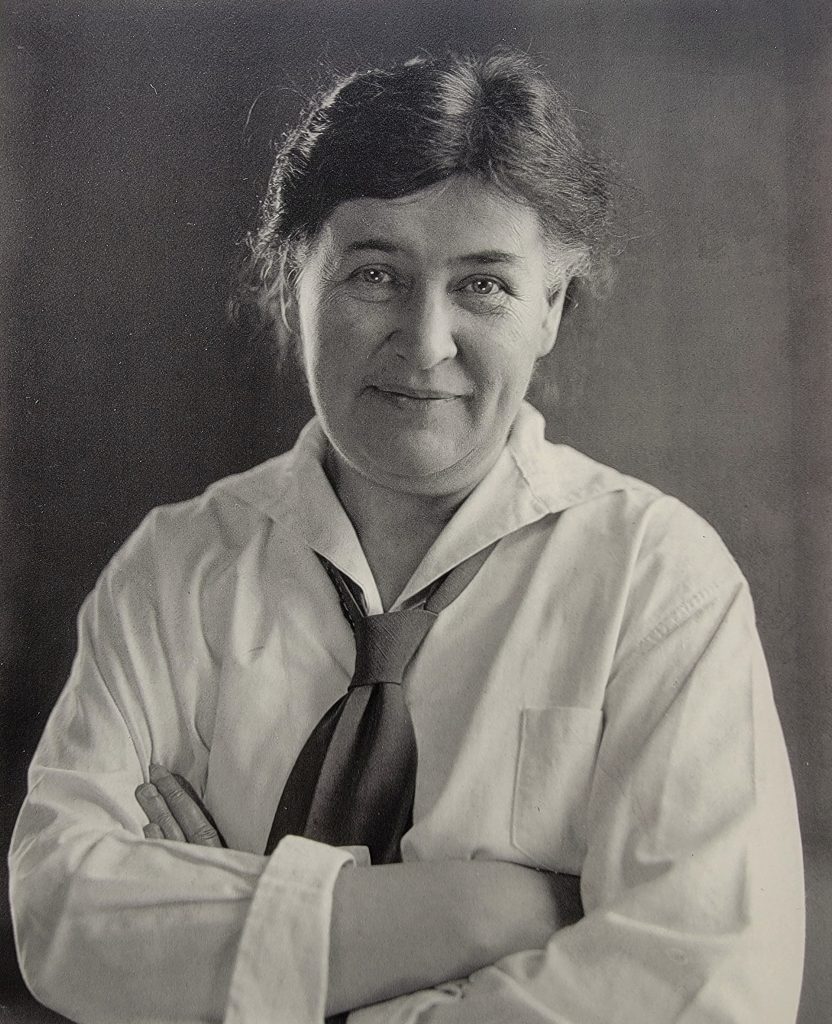
Willa Cather in 1927
by Edward Steichen
The true story involves not flames—but a legal will which Cather left when she died.
It turns out that Willa Cather’s will contains some very strict prohibitions.3
Her executor was her 24-year-old nephew, Charles—and Charles
faithfully followed her strictures for a very long time. Till he died, in fact:
64 years later.
So what is in this will?
And what were these unpublished letters that she was
so adamant about hiding?
These lively, illuminating letters…
reveal Cather herself to be a complicated,
funny, brilliant, flinty, sensitive,
sometimes confounding human being.
– Jewell & Stout4
You know how she absolutely refused to let the world
in on her personal life. She often said…that
everything the world was entitled to know was in her books.
She had to have that feeling of security… It was necessary
for her very life as an artist.
– Edith Lewis5
Cather’s partner & biographer
But before we open any forbidden correspondence—
let’s take a look Willa Cather herself:
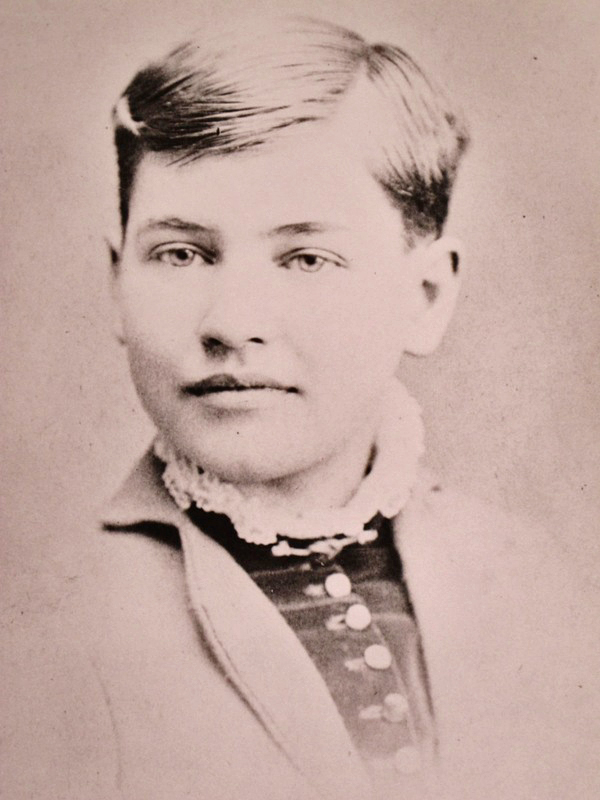
.
Starting with…
A girl on a prairie—wearing
suspenders,
a crew-cut,
and a derby hat.6
.
Willa Cather in 1886 at age 13
Philip L. and Helen Cather Southwick Collection
Willa Cather’s Life
in 4 Chapters
Chapter One:
A Long Wagon-Ride
What are families for, anyway?
– Young Vickie in “Old Mrs Harris”
by Willa Cather
Willa Cather was born into a family in conflict.
She was born Wilella Cather (which her family soon shortened to Willa, or even Willie)
in Back Creek, West Virginia—just 150 miles south of the Mason-Dixon Line,
on December 7, 1873—just 8 years after the end of the American Civil War.
Being born so soon after the Civil War also meant
she was born into into a very intense mythology.
– Margo Jefferson6
Cather’s extended family disagreed strongly about the war and about Reconstruction—
and these family disputes soon persuade Willa Cather’s parents to leave Virginia.
And so, at age 9, Cather travels over 1000 miles by two-horse wagon,
with her parents and younger siblings, to the Great Plains of Nebraska.
Young Willa was terrified by the unfamiliar countryside.6
Once in Nebraska, her father—briefly—tries farming,
before moving his family into the town of Red Cloud,
where he could start a small real estate and insurance business.7
I was little, and homesick, and lonely . . .
So the country and I had it out together.
And by the end of the first autumn,
the shaggy grass country had gripped me with a
passion that I have never been able to shake.
It has been the happiness and curse of my life.
– Willa Cather, in a 1921 interview
about her family’s move from the
Old South to the Nebraska prairie8
Willa Cather spends the rest of her childhood in Red Cloud, Nebraska.
Later she would base novel after novel on the people & landscape that
she grew to love there.
She used Red Cloud as a model for all her small towns.
She changed the name to Sweetwater, Skyline,
Moonstone, Blackhawk, and Haverford.
But they’re all Red Cloud in disguise.
– Christine Lesiak6
She was a decidedly bookish child—and she had free reign over the large library at home:
reading Dickens, Poe, Stevenson, Kipling, Twain, even Virgil.9
She was given the
great gift of…that Nebraska blankness, of the plains,
She didn’t go through a proscribed kind of education,
a proscribed kind of family life…
Everything was up for grabs.
– Richard Giannone6
By her mid-teens, she’d cut her hair short and dressed in dungarees with suspenders,
and called herself ‘Billy’ and sometimes signed her name ‘William Cather, M.D.’9
Chapter Two:
A Change of Ambition
Her parents made a sacrifice to pay for her education;
And from the minute she left home,
they knew she was wasn’t coming back.
– Christine Lesiak6
At age 16, Willa Cather leaves Red Cloud and moves 150 miles away
to Lincoln, Nebraska, the state capital.
She enters the University of Nebraska wanting to become a doctor,
and begins classes in science and medicine.2
But it’s in her English class where she writes an essay that impresses her professor—
so much so that he submits it to the local newspaper. And it’s published.
Willa Cather sees her name in print for the first time—
she later called it a “hypnotic effect.”10
Suddenly her medical ambitions pale and grow faint:
Now she wants to be a writer.
Soon Willa Cather is managing editor of the school paper, and
working as a columnist and theater critic for two of the state newspapers;
She quickly gains a reputation as a “meat-ax critic”—and the terror of local acting troupes.2
She also begins writing short stories—her first story is published when she was only 21.
(What she doesn’t yet know: almost 20 years will pass before her first novel is published.)
In 1895, Willa Cather earns her Bachelor of Arts degree in English.
After graduation, she’ll work as a magazine editor and an English teacher—
But that will require another move.
Chapter Three:
Finding a job, finding a career, finding love
Newly graduated and 21 years old, Willa Cather begins job hunting.
Yes, she’s still writing for the two Lincoln city newspapers;
Yes, she visits that city often, to see friends or to go out to theater;
Yes, she soon publishes a short story in a national magazine for the first time—
And yet…
She’s back in Red Cloud. Living at her parents’ house. Feeling lonely and restless.
When she writes to friends in the city, she refers to Red Cloud as “Siberia.”11
Finally some friends find her a job as a managing editor—
with a women’s magazine called Home Monthly.
It’s in Pittsburgh, Pennsylvania—over a thousand miles from Red Cloud.
Cather leaps at the chance.
Her new city must have looked huge to Willa Cather.
Pittsburgh’s population in the 1890s was around 300,000—
almost six times the size of her college town of Lincoln, Nebraska.
Yet her new home seems to suit her.
She’s very happy to be working as a professional—
despite the limited scope of subject matter the magazine allowed.
It is not likely that
I will treat more delicate subjects than
‘The Care of Children’s Teeth’ for some years to come.
– Willa Cather4
And Cather finds the setting of Pittsburgh attractive—
and the people fascinating.
Really I like the work…
like it immensely.
It’s a great boon just to be of some absolute use somewhere.
…
Then the town and the river and the hills
would compensate for almost anything.
And I meet so many different kinds of people…
– Willa Cather,
in a letter to a friend
August 18963
One evening at a Pittsburgh theater,
Willa Cather meets one of the loves of her life: Isabelle McClung.
Isabelle McClung is part of a large, social Pittsburgh family,
who own a large, gracious home—and they soon offer Cather a room to stay in.
Living with the McClungs influenced Cather in several ways:
She visits Europe for the first time, on a trip with Isabelle in 1902.
She begins to dress more formally.
Cather…under McClung’s influence,
develops greater interest in female dress,
favoring satins, velvets, and bright colors.
– Sharon O’Brien11
But most importantly,
Isabelle McClung encourages Cather to make more time
for her writing. And soon Cather begins to question whether
the hectic life of journalism is best for her.
She decides teaching might give her more free time.
I want to ask your advice…
The disagreeable features of a newspaper office
seem more disagreeable than ever.
It seems to me a good time…[for] the change
which I have always intended to make…
Would there be any chance for me in
any of the high schools there…?
– Willa Cather in a letter to a friend3
February 4, 1901
Cather’s search for a teaching job is successful—
and she begins working at Pittsburgh’s Central High School.
Willa Cather lives in Pittsburgh for almost a decade:
4 years as an editor & journalist. (At two different publications.)
4 years teaching high school: English, Journalism, and Latin. (At two different schools.)
This is a time of success for Cather’s writing, as well.
She publishes her first book: a poetry collection called April Twilights (1903).
And one more important event for her that same year—
she meets the women she will spend the rest of her life with.
In the summer of 1903, Cather returns to Lincoln for a visit,
and there she meets Edith Lewis, who’s also visiting friends in Lincoln.
Not much is known about this first meeting between Edith & Willa.
But it seems, from the beginning, Lewis was helpful and welcoming—
A new friend—who just happened to live in New York City.
My plan is to spend the summer in New York,
down near or with Edith Lewis…
She has been a regular trump about
looking up rooms for me and such things.
…
I think Miss Lewis would be a good pilot for me,
she’s all wrapped up in her discoveries in local color.
– Willa Cather in a letter to a friend
March 19043
The years 1905 and 1906 completely change Willa Cather’s life.
Her first book of short stories, The Troll Garden, comes out in March 1905,
published by McClure, Phillips & Co.
A little more than a year later, Willa Cather gets a visit from S S McClure himself.
But McClure didn’t come all the way from New York to Pittsburgh to
talk about her book. Instead he offers her a job:
He wants to hire her as an editor for McClure’s Magazine.3
June 6, 1906
Dear Boys and Girls…
Now that I find that I shall not return to the
High School next fall, I have a word to say to you…
I should hate to have you think that I had not answered you squarely
when you were good enough to ask whether I should return.
…
One always has to choose between good things it seems.
So I turn to a work I love with very real regret…
having to take leave of so many students
whom I feel are good friends of mine.
…
As long as I stay in New York, I shall always be
glad to see any of my students when they come to the city.
I wish you every success…
Faithfully yours,
Willa Cather3
And so, Cather leaves Pittsburgh,
moving out of the house, which for five years she’d shared with Isabelle McClung—
and moves into her new home in New York City into the same building,
if not (yet) into the same apartment—with Edith Lewis.
Was this transition cordial and full of good wishes?
Did Isabelle ever think about moving with Willa? Did Willa ask her to?
Was there drama? Heartache? Feelings of betrayal?
This is where Willa Cather’s insistence on privacy—
and the possible destruction of who-knows-what letters—
makes it impossible for us to know.
The missing letters to Lewis and McClung…are a
disappointing gap in the record.
– Andrew Jewell & Janis Stout3
Autumn 1906 finds Willa Cather living and working in New York City.
Isabelle and Willa certainly remained friends;
they take another trip to Europe together in 1908.
But when Cather returns to New York this time, she moves in with Edith Lewis.
Their Manhattan apartment is in Greenwich Village—
which Lewis later remembered as a “very sedate Bohemia.”5
From then on, Cather and Lewis will live & travel & entertain guests together for
the rest of Willa Cather’s life.
Chapter Four:
New York City
Working for McClure’s Magazine was a big deal.
A prestigious national magazine,
McClure’s was known for both investigative news reporting and literary excellence—
publishing new works by Jack London, F Scott Fitzgerald, Rudyard Kipling,
Arthur Conan Doyle, and Robert Louis Stevenson.3
At that time, no other magazine was as
successful and respected as McClure’s.
– Jewell & Stout3
Willa Cather starts her job at McClure’s as a fiction editor—
but soon takes over editing a series of non-fiction articles (which later turn into a book)
about the woman who founded the Christian Science movement.5
Once again—
although Cather is still writing, and getting some stories published—
she finds her day-work at the magazine is cutting into the time & energy
she needs for her own writing. Just like her newspaper work had back in Pittsburgh.
And once again—a woman steps in to give advice about what Cather needs to do her best work.
This time, it’s a mentor and friend named Sarah Orne Jewett.
And it’s Jewett’s advice—along with a life-changing trip to New Mexico—
that changes Cather’s life once again.
After being introduced in Boston, Cather and Jewett—
a writer Cather had admired for many years—begin writing to each other.
The advice Jewett gives Cather in a 1908 letter has become iconic writing advice.
It essentially said (if I may paraphrase a bit…): Stop trying to be Henry James. And quit your day job.
My dear Willa…I have been thinking about you and…
I cannot help saying what I think about your writing.
…
It is impossible for you to work so hard
and yet have your gifts mature as they should.
…
You need to dream your dreams…
You must find your own quiet center of life.
…
And to write and work on this level,
we must live on it…and defer to it at every step.
…
To work in silence and with all one’s heart,
that is the writer’s lot.
– Sarah Orne Jewett
letter dated December 13, 1908
(You can read the entire letter here)
Willa Cather thanked her. And agreed with her advice:
Her editing job was taking up way too much of her time & energy.
Of course there are…interesting things in the day’s work,
but it’s like going round the world in a railway train
and never getting off to see anything closer.
…The excitement of it doesn’t stimulate me,
it only wears me out.
– Willa Cather
in a letter to Sarah Orne Jewett
December 19, 19084
Yet her boss told her that he didn’t think she was good enough to be a full-time writer.
Mr McClure tells me that he does not think
I will ever be able to do much at writing stories,
that I am a good executive and I had
better let it go at that.
– Willa Cather,
in a letter to Sarah Orne Jewett
December 19, 19083
It took a trip to Arizona and New Mexico to give Cather the courage
to give up that day job.
Now about Arizona: it’s good.
But New Mexico is better…
I am almost sure I could work at Albuquerque, New Mexico.
It is in the most beautiful country I have ever seen anywhere..
…There is a strong pull about the place…
Such color!
– Willa Cather
in a letter to a friend
April 20, 19123

Rio Grande gorge, New Mexico
(photo by my daughter Elle)
Her visit to New Mexico is only a few months long: a summer holiday trip with her brother Douglass.
And at this point in her life, Cather had already been to Europe twice.
But nothing in Europe or anywhere else affects her—or her writing—
the way this trip to the American Southwest does.
The trip gives her landscapes, people, and events that she will later use
in the novels and stories she sets in the Southwest:
like The Song of the Lark, The Enchanted Bluff, Death Comes for the Archbishop…
But more fundamentally, it awakens her to the importance of place—
and gives her ideas for how to write about her own landscape on the prairies of her childhood.5
She had found, just at the point when
her new life as a writer was about to begin,
…not a story of the Southwest, but a sudden sense
of how to deal with her Nebraskan materials.
– Hermione Lee5
Out of this phase of her life came the
pastoral novels about heroic women pioneers…
A reinvention of the American women’s novel—
as a work of art that was not
political, romantic, or didactic.
– Elaine Showalter9
In the fall, Willa Cather returns to New York City
and quits McClure’s Magazine.
The very next year,
she publishes the novel that will make her famous: O Pioneers!
And she dedicates this novel to Sarah Orne Jewett.
Happy 152nd Birthday
** Willa Cather **
– born December 7, 1873
in Back Creek, Virginia
.
Linger Awhile:
Books are the only masterpieces that
the poor man can have as well as the rich.
– Willa Cather12
I’ve been thinking this week—wondering, really—about how I came to
read Willa Cather in the first place?
I’m guessing there was…
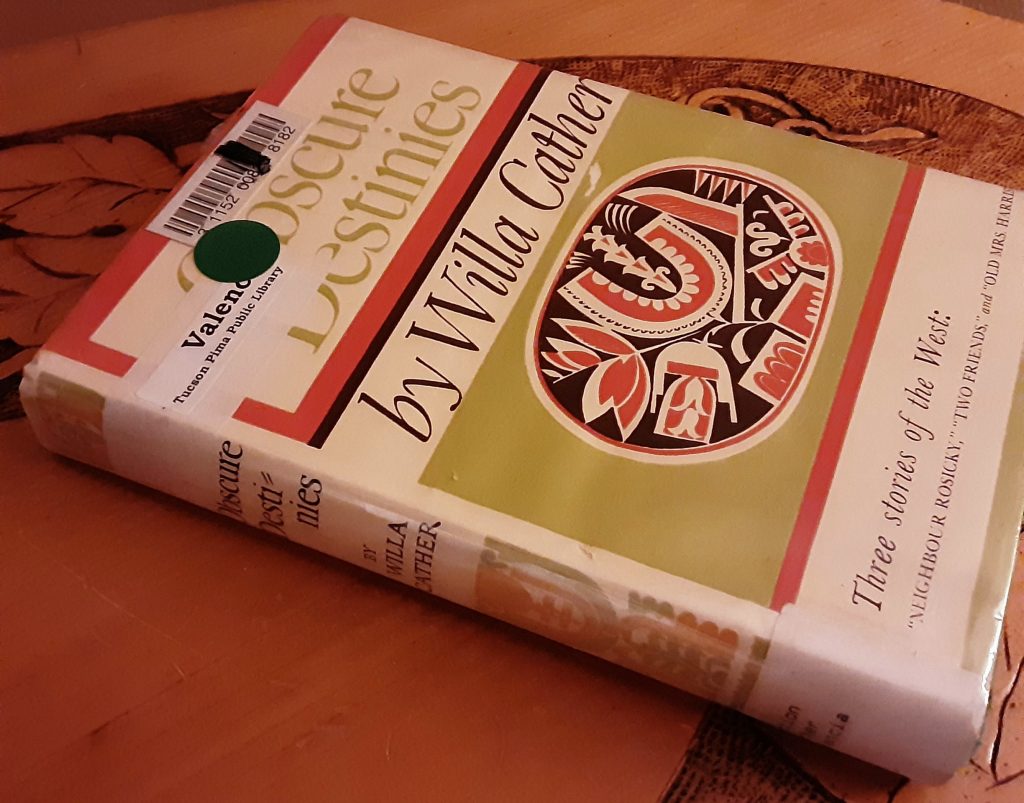
A library book sale.
An appealing cover.
A vaguely familiar “classic” author…
So I paid my $2 (or whatever it was!)
and then let this tidy little hardback sit on my shelves…
for years.
When I finally read Obscure Destinies,
I completely fell in love with the middle story, “Old Mrs Harris.“
But then I let another decade went by before I chose a Willa Cather novel, The Song of the Lark,
to read with my brother for our 2-Sibling Book Club.
Even now, after reading 6 of her novels—and a dozen of her short stories—
“Old Mrs Harris” and The Song of the Lark remain my favorites.
Here’s why…
“Old Mrs Harris“
(1932)
She hurried back to her bedroom,
feeling bitterly that there was no
place in that house to cry in, no spot where
one could be alone, even in misery;
that the house and the people in it
were choking her to death.
– from ‘Old Mrs Harris’
by Willa Cather
I think Cather’s greatest strength is the depth
of the characters she constructs.
She somehow builds them up inside the reader’s own mind.
And there they stay…
I always come away with such a heart for these fictional people!
My gateway drug to Willa Cather was “Old Mrs Harris.“
This novella is not well known.
Probably didn’t help that it never came out as a stand-alone book.
Instead, it’s packaged with two other novellas and given a
begging-to-be-overlooked title like Obscure Destinies: Three Stories of the West.
It’s probably Cather’s most autobiographical work.
If you go to the Cather childhood home
taped quotations from “Old Mrs Harris” illustrate the visit…
The Southern family gone West are her family.
– Elaine Showalter9
The characters in this story have Cather’s
richness and indelibility in spades.
The opening takes us
into the complicated ‘cross-stitching’
of women’s daily lives, women’s work and
women’s preoccupations.
– Elaine Showalter9
But what I love most about this story is the way it sees families:
the primacy of household routines;
how disruptive migration is to communities; and
what a culture clash the customs around motherhood and child-raising can be.
In Tennessee there had been plenty of helpers…
The hills were full of solitary old women…glad to come to
Miz Harris’ for good food and a warm bed, and the little present
…slipped into their carpet-sack when they went away.
– from “Old Mrs Harris“
by Willa Cather
Willa Cather wrote “Old Mrs Harris” late in her own life—
and I feel that there’s a lifetime of wisdom in its 115 pages.
Sometimes in the morning, if her feet ached more than usual,
Mrs Harris felt a little low…. She would hang up her towel
with a sigh…feeling that it was hard to make a start.
But the moment she heard the children
running down the uncarpeted back stairs,
she forgot to be low.
…
She was drunk up into their freshness
when they burst in upon her,
…
The tired, solitary old woman
Grandmother had been at daybreak vanished.
Suddenly the morning…stretched out
sunshiny, important.
– from ‘Old Mrs Harris’
by Willa Cather
The Song of the Lark
(1915)
Of Willa Cather’s full novels, my favorite is The Song of the Lark.
It’s part of Cather’s ‘Prairie Trilogy,’
along with the much more widely-praised My Ántonia and O Pioneers!
All three were inspired by the land and community she grew up in.
Mrs Kronborg was enjoying
the sunshine and the brilliant sky…
All the faintly-marked features of the dazzling,
monotonous landscape.
…
Although she was so enmeshed in family cares…
she could emerge serene when she was away from them.
For a mother of seven
she had a singularly unprejudiced point of view…
She did not attempt to direct things beyond her control.
She found a good deal of time to
enjoy the ways of man and nature.
…
Mrs Kronborg had in her face
the same serious look that Thea had;
only hers was calm and satisfied,
and Thea’s was intense and questioning…
– from The Song of the Lark
by Willa Cather
But The Song of the Lark also travels:
to Chicago, to New York, to Europe, and—
inspired by that life-changing trip Cather took as a 38-year-old—
to New Mexico.
It’s basically a The Artist as a Young Woman kind of story.
Her secret?
It is every artist’s secret…
Passion. That is all.
It is an open secret, and perfectly safe.
Like heroism, it is
inimitable in cheap materials.
– from The Song of the Lark
by Willa Cather
And speaking of artists…
The title of this novel comes from a painting: Listening to the Song of the Lark (1884)
by French artist Jules Breton.
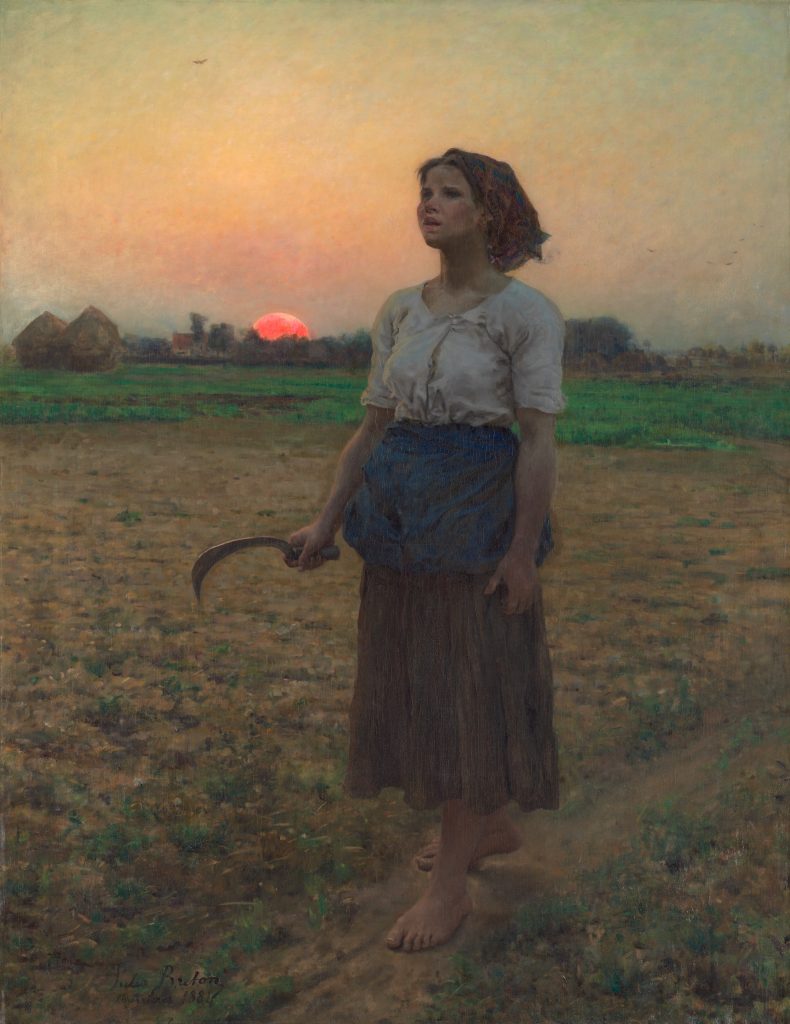
Listening to the Song of the Lark by Jules Breton
Henry Field Memorial Collection, Art Institute of Chicago
What makes The Song of the Lark my very
favorite of Cather’s novels is how we see the world growing bigger and bigger
for this small-town girl and—as she grows into herself—we get to tag along with her.
.
“Half Cup More”
She takes so much pains
to conceal her sophistication
that it is easy to miss her quality.
– Wallace Stevens7
Willa Cather’s books have had something of
a roller-coaster ride in public opinion.
In the 1910s, she introduced the American pioneer experience
to a wider American audience—especially to the urban East Coast.
Her detailed and sympathetic descriptions of immigrant life
made her popular with international readers, and her books were widely translated.2
Sinclair Lewis praised her work for making Nebraska available to
the wider world for the first time.13
F Scott Fitzgerald called his novel The Great Gatsby a failure
compared to Cather’s novel My Ántonia.13
Willa Cather won the Pulitzer Prize in 1923;
for a war novel called One of Ours.
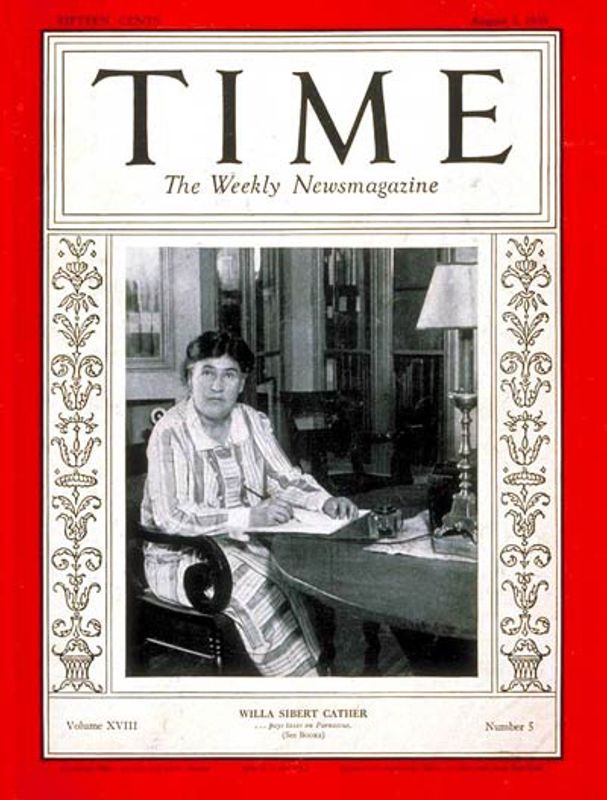
She made the cover of Time magazine in 1931,14
Despite all this, popular taste at the time had begun to swing away from Cather:
Sometime in the 1920s she began to be dismissed as a ‘regional’ writer.2
Then—beginning in the 1960 & 1970s—
Cather’s books were rediscovered by scholars and feminist thinkers.
In the 1920s, Willa Cather’s sober fiction was
overwhelmed by the showmanship of
Sinclair Lewis and Ernest Hemingway…
[But now] her novels are more readable than theirs.
Her spare and supple writing has a classical simplicity…
Her signature is bold on every page.
…
The signature of…a woman of conscience and insight
who was also a scrupulous craftsman…who tries,
without self-consciousness, to express clearly
what she knows about men and women.
– Brooks Atkinson15
New York Times
Nov 24, 1961
Which brings us today,
when Willa Cather is not nearly as well read as she and her writing deserve.
Below is a quick tour through a few books by Cather—with a few recommendations by me.
A Tour of Novels
by Willa Cather
Alexander’s Bridge
(1912)
I haven’t read this one. It’s Willa Cather’s first novel—
published when she was almost 40 years old.
And Cather herself called it a failure.5
Mostly because it was too much in the style of Henry James, a writer she admired,
but regretted imitating so closely.16
O Pioneers! (1913) and
My Ántonia (1918)
These two novels are by far her best known—especially My Ántonia.
They are the 1st and 3rd books in her ‘Prairie Trilogy.’
The earth was warm under me,
and warm as I crumbled it through my fingers…
I kept as still as I could. Nothing happened.
I did not expect anything to happen.
I was something that lay under the sun and felt it,
like the pumpkins,
and I did not want to be anything more.
I was entirely happy.
Perhaps we feel like that when we die
and become a part of something entire,
whether it is sun and air, or goodness and knowledge.
At any rate, that is happiness;
to be dissolved into something complete and great.
When it comes to one, it comes as naturally as sleep.
– from My Ántonia
by Willa Cather
Despite My Ántonia being so much more famous, I believe O Pioneers! is a better book.
Both stories focus on a strong, interesting female pioneer character;
but O Pioneers! is told from the perspective of the pioneer woman herself;
whereas My Ántonia has a first-person male narrator who describes the pioneer woman.
Also I feel like O Pioneers! has a better arc—
and much more depth to both to the characters and to the story itself.
I decided not to ‘write’ at all—
simply to give myself up to the pleasure of
recapturing in memory people and places I’d forgotten.
– Willa Cather17
in a 1921 interview
about writing O Pioneers!
The title O Pioneers! comes from a poem by Walt Whitman,
who was still writing and revising Leaves of Grass when Cather was in high school.18
Willa Cather dedicated O Pioneers! to Sarah Orne Jewett:
“in whose beautiful and delicate work there is perfection that endures.”
One of Ours (1922)
This is the book that won Willa Cather the Pulitzer Prize.
Ironically, she got her biggest prize for what is now probably her least read book.
(I haven’t read it, either.)
One of Ours is a historical novel about a Nebraska farmer boy who goes to fight in France
during World War One.
A Lost Lady (1923)
and
My Mortal Enemy
(1926)
I liked both of these!
Both are slim novels about a strong woman whose life choices
run counter to society’s expectations…
In A Lost Lady, I liked the female main character very much.
Not sure how much we’re supposed to be sympathizing with the male main character, however.
(I really didn’t care for him.)
The plot of A Lost Lady is essentially this:
A young man puts a grown woman up onto a pedestal.
(She is married, by the way—and not to him.)
Then he gets pouty when she won’t stay up there.
My Mortal Enemy is called “most severe and…most furious of Cather’s novels.”19
But I found it… I don’t know, hardy.
A woman choosing to live her life in her own way—not sacrificing herself.
My aunt often said that Myra was incorrigibly extravagant;
but I saw that her chief extravagance was in caring for so many people,
and in caring for them so much.
When she but mentioned the name of someone whom she admired,
one got an instant impression that the person must be wonderful,
her voice invested the name with a sort of grace.
…
When she addressed Aunt Lydia, for instance,
she seemed to be speaking to a person deeper down than the
blurred taken-for-granted image of my aunt that I saw everyday…
Her manner of addressing my
relatives had made them all seem
a little more attractive to me.
– from My Mortal Enemy
by Willa Cather
The Professor’s House (1925)
and
Shadows
on the Rock
(1931)
Two more I haven’t read.
Shadows on the Rock is set in Quebec. It’s not well known.
The Professor’s House is about a man with a midlife crisis, and a family dealing with grief.
Though this doesn’t sound like my cup of tea, Elaine Showalter called it “Cather’s greatest novel.“9
Lucy Gayheart (1935)
This one I have on my shelf to read next!
Death Comes for the Archbishop (1927)
In New Mexico he always awoke a young man;
Not until he rose and began to shave did
he realize that he was growing older.
His first consciousness was a sense of the
light dry wind blowing in through the windows, with
the fragrance of hot sun and sage-brush and sweet clover;
A wind that made one’s body feel light
and one’s heart cry ‘Today, today,’
like a child’s…
Those light-hearted mornings of the desert…
That wind that made one a boy again.
– from Death Comes for the Archbishop
by Willa Cather
I suspect this one is Cather’s masterpiece.
It’s quiet. And it’s slow. Yet so, so rich…
You really feel that place in that time.
With that dust…
Death Comes for the Archbishop may be the
most important novel about American religion.
Why doesn’t every American high school student
have to read this?
– John Green20
Oh! and the mules! (You’re gonna love the mules.)
Their names are Angelica and Contento.
They are always ridden together…
They might pine if they were parted for long…
Mules, as you know, have strong affections.
– from Death Comes for the Archbishop
by Willa Cather
It’s a history lesson, a geography lesson—a heart lesson, too—
about friendship, about loss, about aging…
Father Vaillant began pacing restlessly up and down as he spoke…
It was just this in his friend that was dear to him.
“Where there is great love, there are always miracles,” he said at length.
“One might almost say that an apparition is
human vision corrected by divine love. I do not see
you as you really are, Joseph; I see you through my affection for you.
The miracles [are only]…our perceptions being made finer, so that
for a moment our eyes can see and our ears can hear what is
there, about us, always.”
– from Death Comes for the Archbishop
by Willa Cather
Sapphira and the Slave Girl (1940)
This is Cather’s last novel—published just a few years before she died.
I have not read this one.
Although she was still quite young when her family left the South,
Willa Cather did keep some memories of those immediate-post-slavery years
there in Virginia.
And so she crafted Sapphira and the Slave Girl out of a real-life incident;
however equivocal her ability to correctly remember or to
reliably interpret those incidents she witnessed as a child.
Toni Morrison, in her 1992 book of essays Playing in the Dark,21
commends Cather for taking on these fraught subjects.
The novel’s complexities and its problems of execution
[come from Cather’s] struggle to address an
almost completely buried subject:
The interdependent working of power, race, and sexuality…
[as Cather] imposed ‘all-rightness’ [to] untenable, outrageous circumstances.
– Toni Morrison21
Morrison doesn’t feel Cather was particularly successful at getting
to where she clearly trying to go with these issues—
issues which Morrison calls “complex” and “difficult at best.”
Morrison concludes by saying Cather “may not have arrived…
but to her credit, she did undertake the dangerous journey.”21
.
Take-Away Box
The greatest thing we saw from that mill tower
was the coming of a storm.
The moon did not show herself at all—
There was a long black bank of clouds in the west,
and the lightning kept playing along it
as steady as the fire of a battery.
The world seemed to get ready for a storm;
the cattle all huddled together in one end of the corral,
the corn leaves got restless and began to
toss their long blades up as if to
reach for rain.
In a moment the big wind struck us…
And we fifty feet up in the air on a four-foot platform!
…
The descent was something awful,
the tower shook and we shook—
The wind hummed and sang and whirled all about us.
If it had not been for Ross’ grip on me I believe I should have fallen.
– Willa Cather at age 19
in a letter to a friend
Aug. 1, 1893
Red Cloud, Nebraska
Thank you for reading!
— Kelly J Hardesty
Thoughts? Questions?
I would love to hear what you’re thinking!
Go ahead & scroll down to the end—where you can
leave me note in the comments box.
notes & footnotes
————————-
1.
from the first page of My Ántonia
by Willa Cather
1918
2.
Willa Cather Archive
University of Nebraska–Lincoln
“Longer Biographical Sketch” by Amy Ahearn
updated 2023
https://cather.unl.edu/life/longbio
3.
“Willa Cather’s letters published in defiance of her will”
by Alison Flood
The Guardian
March 26, 2013
https://www.theguardian.com/books/2013/mar/26/willa-cather-letters-published-will
4.
The Selected Letters of Willa Cather
edited by Andrew Jewell & Janis Stout
2013
5.
Willa Cather: Double Lives
by Hermione Lee
1989
Lee quotes Edith Lewis, Cather’s partner, in a
letter to S. Tennant (who was an admirer of Cather)
dated June 1952
written five years after Cather’s death
6.
Willa Cather documentary
PBS @AuthorDocumentaries
written by Christine Lesiak
directed by Joel Geyer
2005
https://www.youtube.com/watch?v=_1AJDk9QCkk&t=32s
featuring:
Cynthia Griffin-Wolff, Cather biographer
Margo Jefferson, Columbia University
David McCullough, Pulitzer Prize winning historian
Joseph Urgo, University of North Carolina-Asheville
Joan Acocella, New Yorker magazine
Richard Giannone, biographer
Susan Rosowski, Cather biographer
7.
Willa Cather: A Literary Life
by James Woodress
1987
8.
Willa Cather in an interview with the Omaha Bee
about her family’s move from Virginia to Nebraska
the South to the Nebraska prairies
“Lure of Nebraska Irresistible, Says Noted Authoress”
October 29, 1921
9.
A Jury of Her Peers: Celebrating American women writers
by Elaine Showalter
2009
10.
Books on Willa Cather Recommended
by Andrew Jewell
The New York Society Library
December 20, 2017
11.
Willa Cather: Stories, Poems, and Other Writings
The Library of America
edited and with notes by Sharon O’Brien
1992
12.
From “Old Books and New”
a magazine article byWilla Cather,
writing under the pen name Helen Delay
in The Home Monthly
May 1897
https://cather.unl.edu/writings/nonfiction/nf031
A (partial?) list of Willa Cather’s Pen Names:
• George Overing
• Helen Delay
• Elizabeth L. Seymour
• Henry Nicklemann
• Fanny Cadwallader
13.
Omaha World-Herald
April 9, 1921.
Sinclair Lewis praised Cather’s novels & stories
for making Nebraska available
to the wider world for the first time.
14.
Willa Cather, on the cover of Time magazine
3 August 1931
https://content.time.com/time/magazine/0,9263,7601310803,00.html
x
x
x
And Cather hated this cover photo!
I refuse to autograph the
hideous snap-shot in Time, my dear boy!
Here is a passport picture that is a good likeness.”
– Willa Cather
in a note to an unknown recipient
October 1931
source: Willa Cather Archive
https://cather.unl.edu/
15
“Critic at Large; Something Failed Willa Cather in 1922
But She Did Not Fail Her Craft”
by Brooks Atkinson
New York Times
Nov. 24, 1961
https://www.nytimes.com/1961/11/24/archives/critic-at-large-something-failed-willa-cather-in-1922-but-she-did.html
16.
Sarah Orne Jewett
in a letter to Willa Cather
dated December 13, 1908
from Letters of Sarah Orne Jewett
edited by Annie Fields
Copyright 1911
You can read the whole letter here…
https://www.sarahornejewett.org/soj/let/letters.htm#144
17.
Willa Cather in a 1921 interview with Bookman Magazine
Reprinted in “Willa Cather and Her First Book” by Bernice Slote
University of Nebraska Press 1968
18.
Willa Cather chose the title of her 1913 novel O Pioneers!
from a passage of the 1855 book-length poem Leaves of Grass
by American poet Walt Whitman.
…O you daughters of the West!
O you young and elder daughters! O you mothers and you wives!
Never must you be divided, in our ranks you move united,
Pioneers! O pioneers!
…
Not for delectations sweet,
Not the cushion and the slipper, not the peaceful and the studious,
Not the riches safe and palling, not for us the tame enjoyment,
Pioneers! O pioneers! …
– Walt Whitman
You can read more about Whitman
in my November 2021 post called: Walt
https://sky-t-tray.us/walt/
19.
Marcus Klein, Barnard College
in his 1961 foreword to My Mortal Enemy (1926) by Willa Cather
20.
18 Great Books You Probably Haven’t Read
by John Green
https://www.youtube.com/watch?v=JgDwaJ0WCVE
21
Playing in the Dark: Whiteness and the Literary Imagination
by Toni Morrison
1992
STT-79
Please note:
Whenever you click on ‘Post Comment’ your comments always come to me first. Then I post them below.
If you’d rather they stay between us, just let me know.
sky-t-tray.us
© Kelly J Hardesty 2026